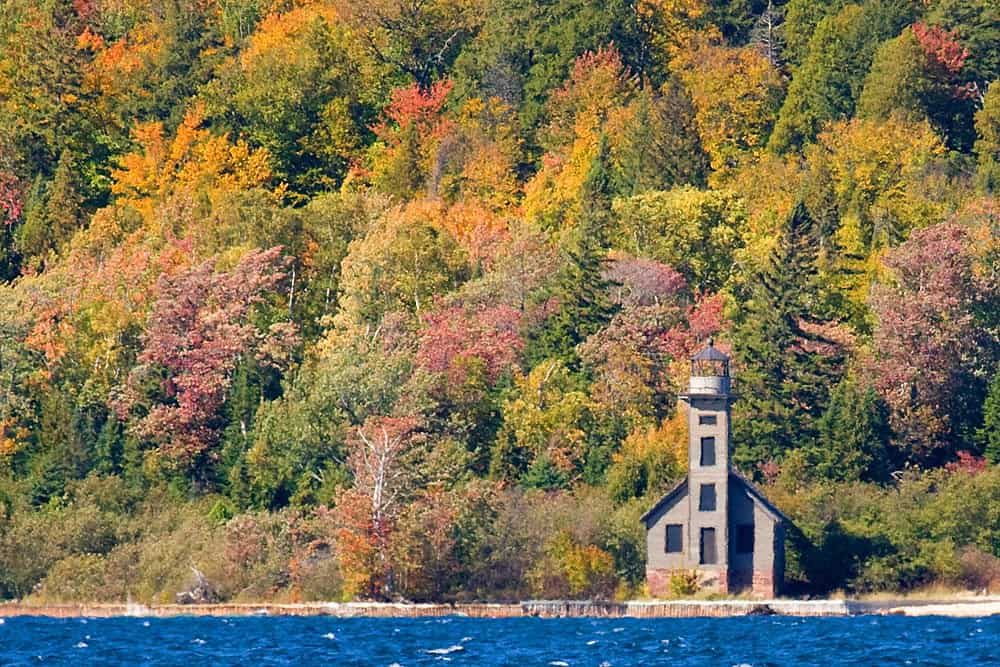
Half a mile off Munising sits an island most people only ever photograph from a Pictured Rocks boat. They are usually photographing it without knowing it, because the famous weathered wooden lighthouse on every Munising postcard, the East Channel Light, stands on Grand Island. What almost nobody in those boats knows is the stranger story behind it: a century and a quarter ago, armed guards patrolled this shoreline, because the most powerful mining executive in the Lake Superior country was turning the island into his own private ark.
People were here long before that. The Grand Island Band of Anishinaabeg made the island home for generations, and in 1841 the band’s chief invited a trader named Abraham Williams to settle at the island’s south end. The spot where his trading post stood is still called Williams Landing, and it is still where the ferry drops you today.

A private ark on Lake Superior
Around the turn of the century, William G. Mather, president of the Cleveland-Cliffs Iron Company, bought Grand Island as a personal retreat, and in 1901 he established the Grand Island Forest and Game Preserve. Then he started filling it. Eleven elk arrived in 1902, followed by caribou, antelope, and mule deer, by some accounts moose and mountain goats, plus imported game birds with names like the capercailzie, and a fish hatchery pumping out landlocked salmon and steelhead. He built a 23-mile carriage road around the island so guests could tour it by buggy, opened the Hotel Williams for tourists, and posted a land agent and armed men to keep poachers off his investment. In today’s money, he spent millions building a private Yellowstone, with dreams of a northern playground to rival Mackinac Island.

Winter had other plans
Lake Superior was not consulted, and it voted no. The imported animals met U.P. winters and the island’s wolves, and many of them simply did not survive. The exotic-game experiment withered, the playground for the rich never quite materialized, and the preserve was eventually dismantled, though the hotel hung on all the way to 1959. Mather himself never lost his affection for the place. He protected the island’s old-growth forest his whole life.
Which makes the next part hurt. After Mather died in 1951, his own company logged roughly 80 percent of the forest he had spent half a century protecting. It is one of the quiet heartbreaks of U.P. history: the conservationist’s island, cut by the conservationist’s company.
The island got the last word
In 1990 the U.S. Forest Service bought Grand Island from Cleveland-Cliffs, and Congress designated all 13,500 acres a National Recreation Area within the Hiawatha National Forest. The forest is growing back over the old carriage roads, and the public owns nearly all of it now.
Going is easy and feels like a small expedition. The ferry runs seasonally from Grand Island Landing, about four miles west of Munising off M-28, and lands you at Williams Landing in minutes. No visitor cars are allowed, so bring a bike or strong legs: the island has about 30 miles of trails, the water off the cliffs is absurdly clear, and Trout Bay’s mile of sand is one of the finest beaches on Superior. There are 17 rustic campsites if you want to stay, and a narrated bus tour if you would rather ride. And when you pass the East Channel Light, you will know something the boat tourists photographing it do not: this island was once one man’s ark, and the lake took it back. There is also an unsolved lighthouse mystery from 1908 out here, but that one deserves its own story.
More worth reading


Sources, credits, and reporting details
Sources & accountability
How this story was reported
Editorial methodArchival synthesis
Last verifiedAug. 15, 2026
Corrections statusNo material correction note is recorded on this article.
AI assistanceResearched and drafted with AI tools. Reviewed and approved by editor Keegan O’Brien.
Verification note: Ledger reconstructed 2026-08-15 from the article's Sources line (the DNR's Outdoors North column in the Mining Journal; the Hiawatha National Forest's Grand Island cultural resources report; the U.S. Forest Service; Mikel B. Classen's Grand Island history), checked against the Mining Journal column and the Forest Service's Grand Island National Recreation Area pages.
Primary sources
-
Grand Island marks deep connections to area (Outdoors North) — The Mining Journal / Michigan DNR
Published Feb. 1, 2017. Accessed Aug. 15, 2026.
-
Grand Island National Recreation Area — U.S. Forest Service, Hiawatha National Forest
Accessed Aug. 15, 2026.
Supports: Current management of the island as a national recreation area, access and rules.
Additional reporting
-
Grand Island: Island of History and Mystery — Mikel B. Classen
Accessed Aug. 15, 2026.
Supports: Book-length history of the island, including the Mather era.
Print book, no public link; listed as the fuller account.
-
Grand Island View historical marker — Pictured Rocks National Lakeshore, National Park Service, via HMdb
Accessed Aug. 15, 2026.
Supports: Marker text on the island's history.
Photo and media credits
-
Grand Island East Channel Lighthouse (featured image) — James Phelps, via Wikimedia Commons
Featured image record. Accessed Jul. 23, 2026. CC BY 2.0.
Creator and license from the attachment caption. Attachment 1831, 1000×667.