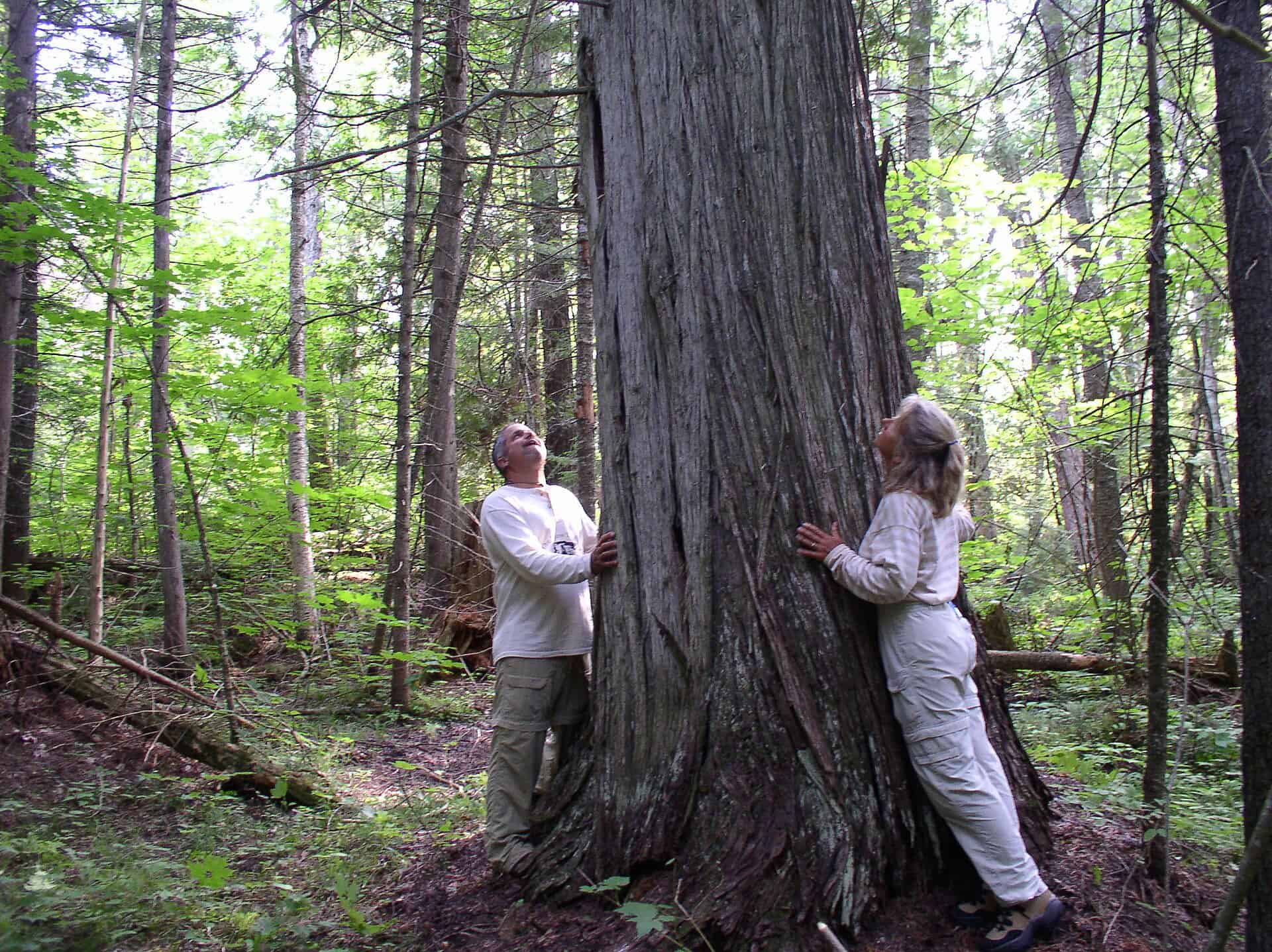
At the very tip of the Keweenaw, down a pothole dirt road south of Copper Harbor, stands a forest that should not exist. White pines 12 stories tall, some alive since before Michigan was Michigan, one of them rooted since around 1695. Nearly every tree like them in the state went to the sawmills a century ago. These survived for the strangest of reasons, and then, when their turn on the stump finally came in 1970, the people of the Keweenaw simply refused to allow it.
The name on the forest belongs to a man who likely never swung an axe here: Edward Estivant, a landowner from Paris, France, whose family held this 2,400-acre tract through the logging era while the rest of the U.P. was cut bare. The land passed to the Calumet and Hecla mining company in 1947, and then in 1968 to Universal Oil, which promptly cut roughly 300 acres of the surrounding old forest and made plans to keep going. The last giants of the Keweenaw had a date with the mill.

A newspaper column starts a rescue
The rescue began the way a lot of U.P. stories do, with somebody speaking up in the local paper. In 1970, a local citizen named Lauri Leskinen wrote a column in the Daily Mining Gazette saying plainly that the pines had to be saved. A “Save the Pines” committee formed around co-chairs Charlie Eshbach and Jim Rooks. Eshbach also carried a camera. One of his photographs of the logging ran in the Milwaukee Journal on March 6, 1971, and the regional attention it drew was enough to make Universal Oil stop cutting. The Michigan Nature Association took the cause statewide, and for three years the money came in from everywhere, big donors and small ones, including local schoolkids who raised what they could. The price for 200 acres of irreplaceable forest was 56,000 dollars. On August 17, 1973, the committee held the deed.
It was the beginning, not the end. Additional purchases between 1989 and 2019 grew the sanctuary to more than 570 acres, including a 2019 expansion funded by a 90,000-dollar challenge grant that Michigan donors matched dollar for dollar. Where the Porkies’ old growth was saved by the state in 1945, the Estivant Pines were saved retail, by ordinary people passing the hat.

Walking among the giants
Today the Michigan Nature Association keeps the sanctuary open year-round, free, for feet only, no bikes. Two connected loops thread through it: the one-mile Cathedral Grove trail, which earns its name the moment you stand under pines pushing past 125 feet, and the 1.2-mile Bertha Daubendiek loop, named for the MNA’s founder. The forest holds more than 85 bird species, including 15 kinds of warblers, plus pine martens, orchids, and a floor of ferns.
And then there is the fallen king. The Leaning Giant was the most famous tree in the Keweenaw, a white pine eight feet through the trunk, crowned a Michigan champion in 1971. A ferocious north wind finally brought it down in 1987, but the forest did not tidy it away. Adventurous hikers still cross the Montreal River on a rough trail to stand beside the massive trunk where it lies, which is its own kind of lesson in how long a great tree lasts, even on the ground.
If you go
From Copper Harbor, take 2nd Street out of town, which becomes Manganese Road, then follow Clark Mine Road to Burma Road and the sanctuary lot. Stop at Manganese Falls on the way, because it is right there. Wear real shoes, bring bug spray, and give yourself more time than the mileage suggests, because you will spend a lot of it standing still and looking up. In winter, snowshoes, since this corner of the Keweenaw catches around 275 inches of snow. The trees will be there. The neighbors made sure of it.
Go See It: Estivant Pines Nature Sanctuary — address, hours, cost, season and drive times.
Go See It
Estivant Pines Nature Sanctuary
- Hours
- Open year-round, no gate. Roads, parking and trails are not plowed or maintained in winter.
- Cost
- Free. No entry or trail fee. The Michigan Nature Association sells a $0.99 downloadable trail map; memberships and donations are requested but not required to visit.
- Season
- Any season works for viewing the pines; spring (wildflowers, fewer bugs) and fall (color) are most recommended. Winter hiking and snowshoeing are popular and MNA-supported, but the access road and trails are not plowed or maintained in winter.
- Drive
- From Marquette: 2 hr 51 min, 145 miles via US-41 N (Google Maps route, usual traffic, read Sept. 27, 2026)
From the Bridge: 5 hr 32 min, 309 miles via US-41 N, with the Mackinac Bridge toll (Google Maps route, usual traffic, read Sept. 27, 2026) - Contact
- Michigan Nature Association, (866) 223-2231, michigannature@michigannature.org.
More worth reading


Sources, credits, and reporting details
Sources & accountability
How this story was reported
Editorial methodArchival synthesis
Last verifiedAug. 15, 2026
Corrections statusNo material correction note is recorded on this article.
AI assistanceResearched and drafted with AI tools. Reviewed and approved by editor Keegan O’Brien.
Verification note: Ledger reconstructed 2026-08-15 from the article's own Sources line (Michigan Nature Association; the Daily Mining Gazette's 1970 Save the Pines record; Michigan Blue; Old-Growth Forest Network), checked against MNA's sanctuary fact sheet and the Old-Growth Forest Network listing. Sanctuary acreage has grown since the original 1973 purchase; MNA's current figure is about 570 acres.
Primary sources
-
Estivant Pines Nature Sanctuary fact sheet — Michigan Nature Association
Accessed Aug. 15, 2026.
-
Estivant Pines Nature Sanctuary (sanctuary listing) — Michigan Nature Association
Accessed Aug. 15, 2026.
Supports: Current sanctuary size, trails and visiting information.
Additional reporting
-
Estivant Pines Nature Sanctuary — Old-Growth Forest Network
Accessed Aug. 15, 2026.
Supports: Recognition of the stand as old-growth white pine and its inclusion in the network.
-
The Estivant Pines historical marker — Western Upper Peninsula Heritage Trail and Michigan Nature Association, via HMdb
Accessed Aug. 27, 2026.
Photo and media credits
-
Estivant Pines (featured image) — Fergu186, via Wikimedia Commons
Featured image record. Accessed Jul. 18, 2026. Public domain.
Creator and license from the attachment caption. Commons file Estivant Pines.JPG. Attachment 1812, 1920×1437.