If the Upper Peninsula has one river the whole world has heard of, it is the Big Two-Hearted. Ernest Hemingway put it there in 1925, in a story about a young man named Nick Adams stepping off the train at Seney with a rod and a pack, walking into the burned-over country, and fishing himself back to sanity. A century of readers have loved it, and generations of anglers have made the pilgrimage north because of it. There is just one problem. The river Hemingway was writing about was not the Two-Hearted.
The river in the story, the one that actually runs past Seney, is the Fox. The real Two-Hearted flows through wild country roughly 20 miles to the northeast, in Luce County, and never comes anywhere near the town. Hemingway knew exactly what he was doing.

The confession
Years later, in a piece called The Art of the Short Story, Hemingway owned up to it. The river was the Fox, he explained, and he swapped the name deliberately, not out of ignorance or carelessness, but “because Big Two-Hearted River is poetry.” He was right. Big Fox River does not sound like much of anything. Some Hemingway devotees have long suspected a second motive too, that he was quietly protecting his beloved Fox from the crowds a famous story would bring, though that part is speculation.
The trip behind the story was real. In the summer of 1919, months after coming home from World War I, where a mortar blast had torn up his legs at eighteen while he served as an ambulance driver in Italy, Hemingway rode the train from Petoskey to Seney with two friends and spent a week fishing the Fox country. The story he later built from that trip became a classic about a man quietly holding himself together after the war, without the war being mentioned a single time.
One more invention worth knowing: the smoldering, burned-to-the-ground Seney that Nick finds in the story. Seney’s great fires had actually swept through decades earlier, back in its wild logging days. What Hemingway stepped into in 1919 was not a smoking ruin, just a faded little town the boom had left behind. He borrowed the ashes for the story because the ashes were the point.

The real Two-Hearted is worth the trip anyway
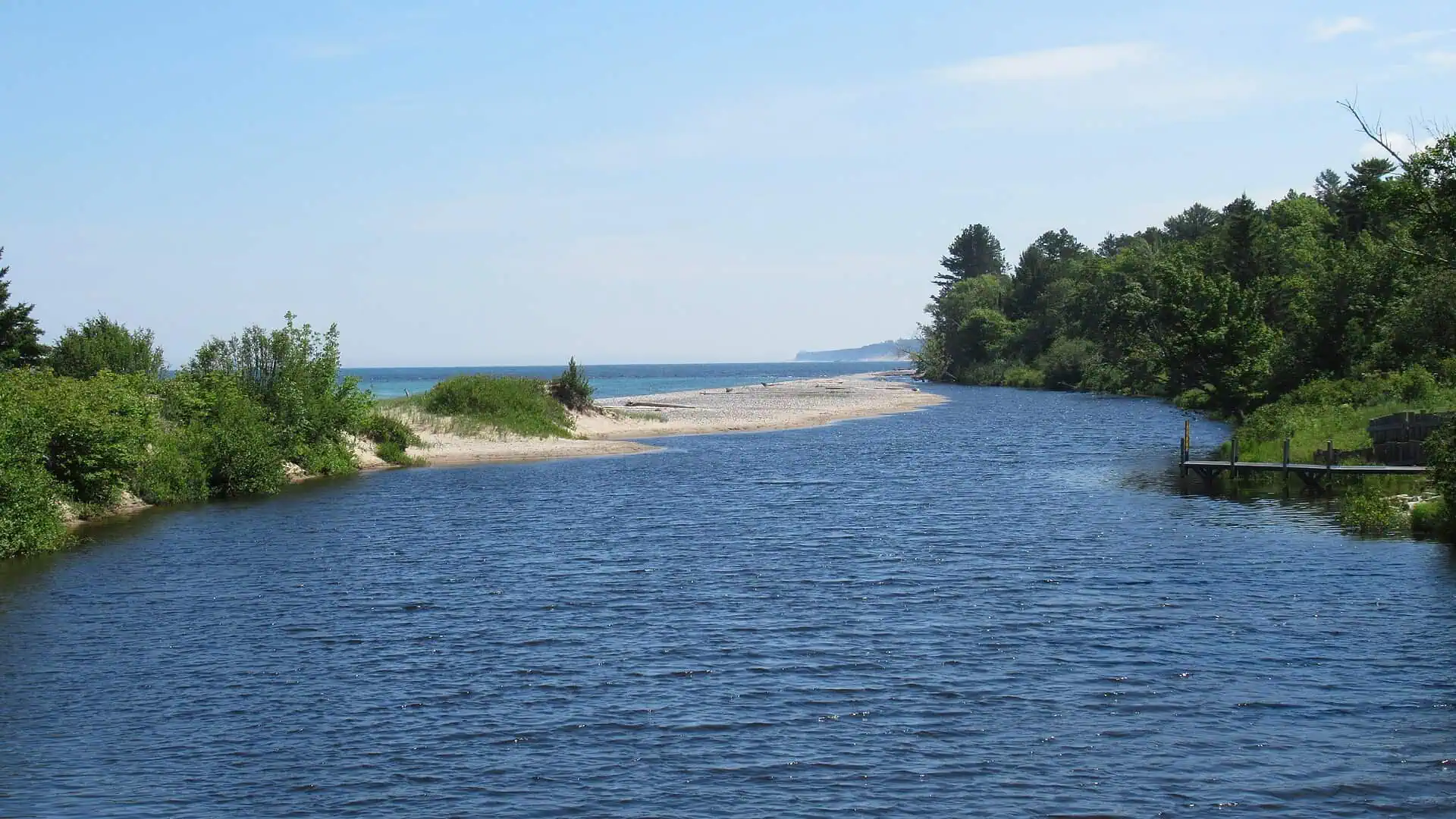
None of this is a knock on the actual river. The Two-Hearted is one of the finest wild trout streams in Michigan, a state-designated Natural River winding about 35 miles through genuinely remote country before emptying into Lake Superior east of Deer Park. At the mouth there is a campground and a suspension footbridge over the river, plus a historical marker for the life-saving station that stood there from 1876 into the 1930s, back when this stretch of coast was wrecking ships regularly. The surrounding forest burned hard in the 2012 Duck Lake Fire and has been steadily coming back since.
And then there is the beer
The river got a second life in the beer aisle. Bell’s Two Hearted Ale, the all-Centennial-hop IPA from Michigan’s Bell’s Brewery, is named for it, and it has been voted the best beer in America multiple times by the American Homebrewers Association, at one point knocking off the legendary Pliny the Elder. Founder Larry Bell has said the name worked on more than one level, since the original recipe had two hearts of its own, English malt and midwestern hops. So the U.P. river Hemingway never actually fished ended up famous twice, once in the pages of American literature and once on the label of America’s favorite IPA. Not bad for a name that got borrowed for being poetry.
More worth reading


Sources, credits, and reporting details
Sources & accountability
How this story was reported
Editorial methodArchival synthesis
Accountable editor:Keegan O’Brien, publisher and editor.
Last verifiedJul. 17, 2026
Corrections statusNo material correction note is recorded on this article.
AI assistanceResearched and drafted with AI tools. Reviewed and approved by editor Keegan O’Brien. Tool: OpenAI Codex.
Verification note: Re-verified 2026-07-17 against the direct records listed here. Two body figures were corrected to match those records: the Two Hearted River mainstream length (now about 35 miles, per Michigan DNR Natural Rivers) and Hemingway's age when wounded in July 1918 (now 18, per his Red Cross war-service record). Method: archival synthesis. No AI-generated or AI-assisted media.
Primary sources
-
Fox River Natural River Plan — Michigan Department of Natural Resources
Accessed Jul. 17, 2026.
Direct state river-management plan. The 25-mile figure describes the river system, while the Lake Superior mouth is roughly 45 miles from Seney.
-
Michigan Natural Rivers: Fox River and Two Hearted River — Michigan Department of Natural Resources
Accessed Jul. 17, 2026.
Current official DNR program page.
-
Hemingway’s Works by First Publication — John F. Kennedy Presidential Library and Museum
Accessed Jul. 15, 2026.
Institutional chronology from the Hemingway archival collection.
-
Hemingway on War and Its Aftermath — U.S. National Archives
Published Mar. 1, 2006. Accessed Jul. 15, 2026.
Federal archival history. Hemingway was born July 21, 1899 and was 18 when wounded July 8, 1918.
-
Bell’s Brewery History — Bell’s Brewery
Accessed Jul. 17, 2026.
Official brewery history.
-
Two Hearted IPA — Bell’s Brewery
Accessed Jul. 17, 2026.
Official current product page.
-
2020 Zymurgy Best Beers in America Results — American Homebrewers Association
Published Jan. 1, 2020. Accessed Jul. 17, 2026.
Official survey result, not a blind judging competition.
Additional reporting
-
Solving the Mystery of Hemingway’s Big Two-Hearted River — John N. Maclean / Mountain Journal
Published Jun. 13, 2023. Accessed Jul. 17, 2026.
Research synthesis drawing on Hemingway’s essay, family correspondence, maps, and Seney testimony.
Photo and media credits
-
Mouth of the Two Hearted River in June 2021 — Notorious4life
Featured image record. Published Jun. 28, 2021. Accessed Jul. 15, 2026. CC0 1.0 Universal; https://creativecommons.org/publicdomain/zero/1.0/.
Supports: Exact source and rights record for attachment 1749, the featured image.
CC0 dedication. Local copy resized from 5184 by 2916 to 1920 by 1080 without cropping; re-encoded by WordPress. Placement: featured. Credit recorded in attachment caption. No AI use.
-
Ernest Hemingway passport photo 40-1548M — Unknown; U.S. Government Printing Office / U.S. National Archives
Published Jan. 1, 1923. Accessed Jul. 15, 2026. Public Domain Mark 1.0; https://creativecommons.org/publicdomain/mark/1.0/.
Supports: Exact source and rights record for body attachment 1750.
Public-domain U.S. federal record, NARA 192693. Local copy resized from 2524 by 3150 to 1920 by 2396 without cropping; re-encoded by WordPress. Placement and credit recorded in caption. No AI use.
-
Brook trout, Salvelinus fontinalis — Eric Engbretson / U.S. Fish and Wildlife Service
Accessed Jul. 15, 2026. Public domain U.S. Fish and Wildlife Service work; https://www.fws.gov/help/policies-and-regulations.
Supports: Exact source and rights record for body attachment 1751.
Public-domain federal work. Commons current file is a lossless crop; Yooper Hub resized it from 2182 by 1135 to 1920 by 999 without an additional crop. Placement and credit recorded in caption. No AI use.
.jpg)

