In November 1913, a single storm tore across the Great Lakes for four days, sank a dozen ships, and killed more than 250 sailors. It remains the deadliest storm in the history of these waters. And it began here, on Lake Superior.
They called it the White Hurricane.
Four days of fury
The storm formed when two weather systems collided over the lakes in early November, an Arctic blast sweeping down from Canada meeting a warm front pushing up from the south, both feeding on the still-warm water below. What it became had no real precedent. Wind gusts reached around 80 miles an hour. Waves towered more than 35 feet. Snow fell for days, more than two feet of it in places, turning the open water into a blinding white chaos.
The men out on those lakes never had a chance to prepare. In 1913, there was no radio on most ships and no modern forecasting. Warnings went out by signal flag and slow telegraph, and by the time the worst hit, much of the fleet was already out on the water. According to the National Weather Service, at least twelve ships went to the bottom, and dozens more were driven ashore or smashed apart on the rocks. The official death toll was 248 sailors, and historians agree the true number was almost certainly higher.
The Henry B. Smith sails into eternity
For the Upper Peninsula, the hardest part of this story sailed out of Marquette.
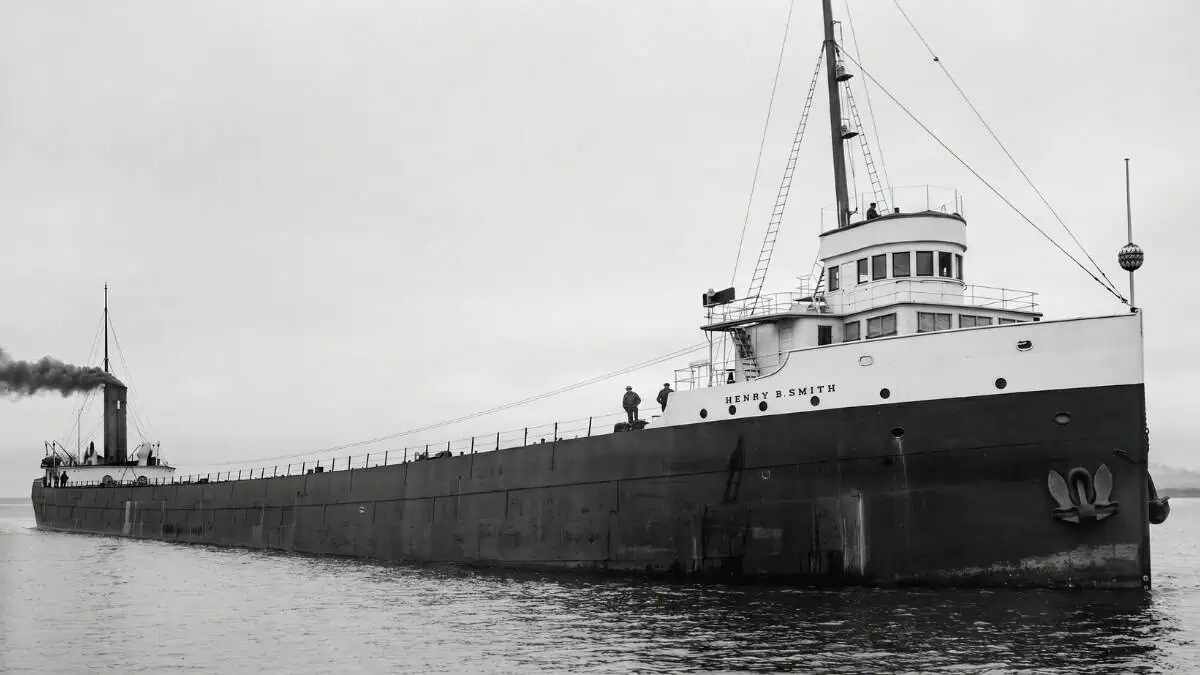
The Henry B. Smith was one of the largest freighters on the lakes, more than 500 feet long. She had spent days in Marquette harbor, delayed and waiting out the weather, loading nearly 10,000 tons of iron ore. Then, on the evening of November 9, with the wind seeming to ease for a moment, her captain, James Owen, made the call to leave the safety of the harbor and head down the lakes.
Sailors on other boats reported watching the Smith’s crew battening down the hatches as she pushed out onto the open lake. They saw her turn, and then the snow swallowed her. The Henry B. Smith was never seen again. All 25 men aboard were lost. The longtime shipwreck historian Julius Wolff later wrote that in leaving that harbor, Captain Owen had “sailed into eternity.”

For a century, the Smith was a ghost. Debris and a couple of bodies washed ashore in the weeks that followed, and in 1914 a sensational claim went around that a message in a bottle described the ship breaking apart twelve miles off Marquette. But the wreck itself stayed hidden in the deep, cold dark.
Then, in May of 2013, almost exactly one hundred years after she vanished, a team of shipwreck hunters found her. The Henry B. Smith lay broken on the bottom under more than 500 feet of Lake Superior, about 30 miles north of Marquette, amid a spilled mountain of her own iron ore. Maritime historian Frederick Stonehouse of Marquette, who had written about the ship for years, called it a chance to finally write its final chapter.
The lake also let some live
Not every story from that storm ended in the deep. Off the tip of the Keweenaw Peninsula, the freighter L.C. Waldo lost her rudder in the dark and was driven helpless onto the rocks near Manitou Island. Her crew huddled in the wrecked, freezing hull for days. But the lifesavers from the Eagle Harbor station rowed out into that same brutal water in a small open boat and brought every last one of them back alive. It is one of the bravest rescues in the history of this coast, the kind of thing the keepers and lifesavers who guarded these lighthouses were built for.
Lake Huron, farther south, fared even worse than Superior. On the single worst night, eight ships went down there in a matter of hours.

A lake that does not forget
The White Hurricane changed things. The sheer scale of the loss forced the shipping world to take weather seriously, leading to better forecasting, faster warnings, and radios on ships so no crew would ever again sail blind into a storm like that.
But for anyone who grew up on Lake Superior, the deeper lesson never really changed. This is beautiful water, and it is also among the most dangerous on earth. Sixty-two years later, the same lake would take the Edmund Fitzgerald and her 29 men, in a storm just as merciless.
The Henry B. Smith and her crew rest where they fell, off the Marquette shore, in the cold and the quiet. The big lake gave the U.P. its iron, its harbors, and its livelihood. In November of 1913, it also reminded everyone exactly who is in charge out there. And more than a hundred years on, it has not forgotten a single soul it took.
Featured image credit: SS Henry B. Smith, the freighter lost in the 1913 Great Lakes Storm. Photo by Edward H. Hart / Detroit Publishing Co., Library of Congress, public domain.
Explore more: Marquette Stories
More worth reading


Yooper Hub community
The conversation
Know something this story missed? Corrections and additions get read by an editor and folded into the article, with credit.
Real neighbors, real names. A Yooper Hub editor reads your first comment before it appears; after that you’re a known neighbor and your comments post right away. No account required. Community guidelines
Nothing here yet. A sentence is plenty: a correction, a name, or what you remember about this place.
Sources, credits, and reporting details
Sources & accountability
How this story was reported
Editorial methodAggregation
Last verifiedJul. 13, 2026
Corrections statusNo material correction identified in the July 13, 2026 source review.
AI assistanceResearched and drafted with AI tools. Reviewed and approved by editor Keegan O’Brien.
Verification note: CEO-directed review checked the central claims against 1 direct public evidence link on July 13, 2026. No material correction was identified.
Primary sources
-
Direct evidence for: The Henry B. Smith Sailed Out of Marquette in 1913 and Vanished With All 25 Men — National Weather Service
Accessed Jul. 13, 2026.
Direct public evidence reviewed against the article on July 13, 2026.
Photo and media credits
-
Henry B Smith LOC — Creator or rights holder named in the WordPress attachment caption
Featured image record. Accessed Jul. 13, 2026. public domain.
Supports: Featured image used by this article.
SS Henry B. Smith, the freighter lost in the 1913 Great Lakes Storm. Photo by Edward H. Hart / Detroit Publishing Co., Library of Congress, public domain.