Drive US-2 through the western U.P., a mile or two past Watersmeet, and you’ll go right by it without a second look: a quiet cluster of fields and greenhouses set back off the old highway. Hardly anyone slows down, and hardly anyone realizes that unassuming spot is the last of its kind in the entire eastern United States.
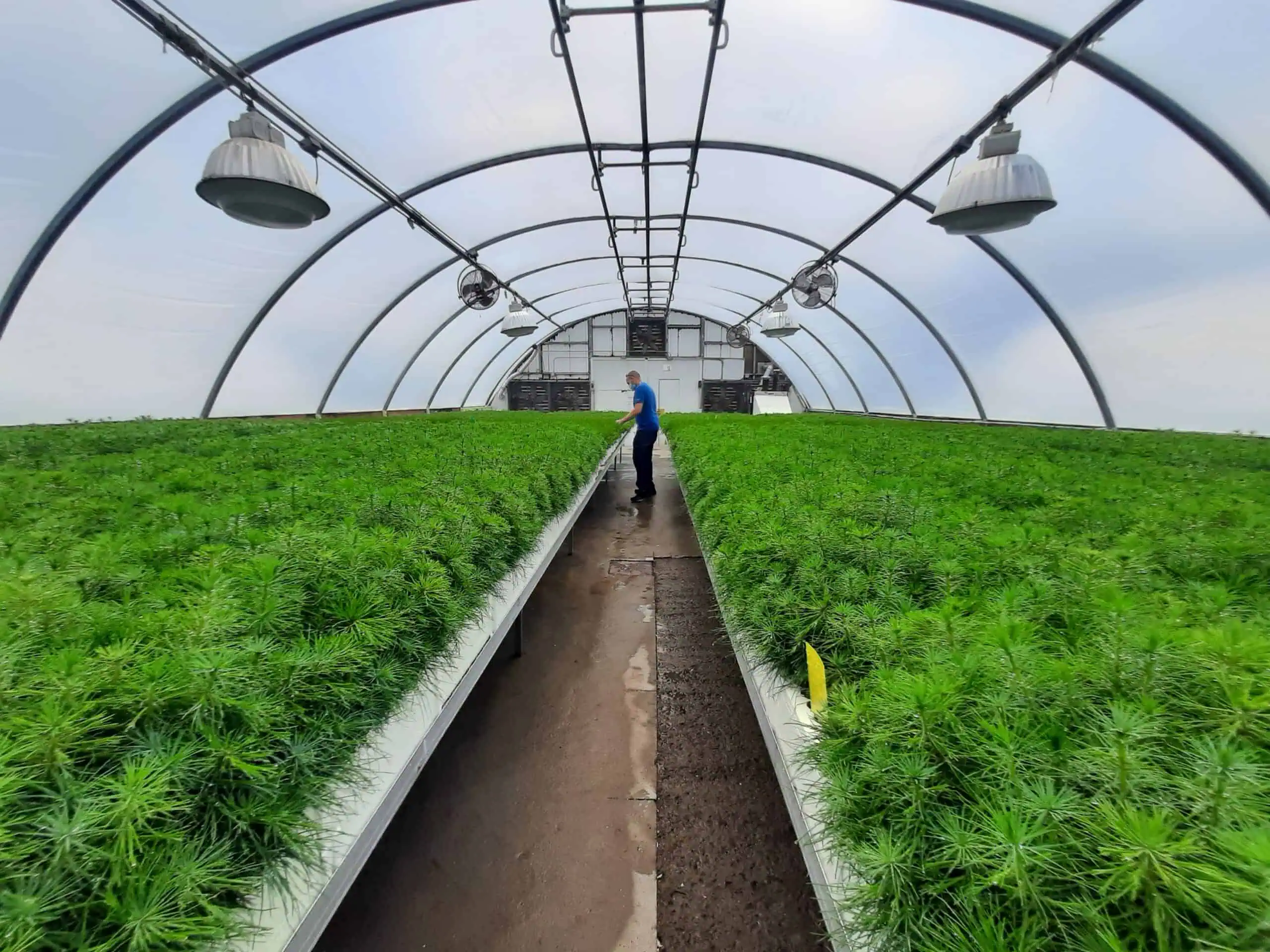
It’s the J.W. Toumey Nursery, and it has been growing trees since 1935. It’s one of only eight tree nurseries the U.S. Forest Service still runs anywhere in the country, and the last one left in the eastern U.S. On 110 acres outside Watersmeet, it grows up to 12 million seedlings at a time and ships around 4 million of them out every year to be planted in national forests, many of them hundreds of miles away.

Where all those trees end up
Here’s the part that’s easy to miss: this little U.P. operation reforests a huge slice of the country. Beyond the Ottawa National Forest right next door, Toumey supplies seedlings and seed to more than a dozen national forests — from the Green Mountain and White Mountain forests in New England, down through the Hoosier in Indiana and the Mark Twain in Missouri, and over to the Superior and Chippewa in Minnesota. National forests across the eastern United States receive at least some of their new trees from Watersmeet. The fields grow mostly red pine, jack pine, white pine, spruce, tamarack, cedar, hemlock, oak, maple, and birch — seedlings that leave the nursery somewhere between one and three years old.
A cactus expert, a Yale forestry dean, and Roosevelt’s Tree Army
The nursery’s name is a story in itself. James W. Toumey was born in Lawrence, Michigan, in 1865, made his name as a cactus expert out in Arizona, and went on to help found the Yale School of Forestry, where he eventually served as dean. He died in 1932; three years later, the new nursery near Watersmeet was named in his honor, and in 1937 a memorial tablet was dedicated to him here by the Yale forestry graduates then working in the Forest Service’s eastern region.
The timing wasn’t an accident. Decades of unchecked logging had stripped Michigan’s forests bare, and the country was deep in the Great Depression. The Civilian Conservation Corps — Franklin Roosevelt’s “Tree Army” — put young men to work replanting the damage, and nurseries like Toumey grew the seedlings they put in the ground. By 1941, Michigan’s four Forest Service nurseries were turning out an average of 97 million seedlings a year. Three of those four — Beal, Wyman, and Chittenden — eventually closed. Toumey is the one that never did.

The part the headlines miss: it’s breeding tougher trees
Most write-ups stop at the seedling counts. But tucked inside Toumey’s greenhouses is something quietly forward-looking — a grafting program aimed at outsmarting tree diseases. Staff take cuttings from trees that have shown natural resistance to pests and disease, then graft them onto new stock. Those grafted trees go to the nearby Oconto River Seed Orchard, and the seed they eventually produce is grown back into seedlings that carry the same resistance. In other words, the nursery isn’t just replacing trees — it’s working to grow forests tough enough to survive what’s coming at them.
And yes, you can go see it
Here’s something even a lot of locals don’t know: the nursery gives tours. They have to be set up ahead of time — you call the office at (906) 358-4523 to arrange one — and it runs weekdays, 6 a.m. to 2:30 p.m. Central, on Old US-2 just northeast of the US-2/US-45 junction in Gogebic County. One heads-up: this is a working nursery, not a visitor center, so you can’t grab trail maps or forest permits here. For those, stop at one of the other Ottawa National Forest offices.
So next time you’re rolling through Watersmeet and catch those rows of little trees off the highway, you’ll know exactly what you’re looking at: the last Forest Service nursery in the eastern U.S., quietly growing trees for forests across the eastern United States, one seedling at a time.
More worth reading


Yooper Hub community
The conversation
Know something this story missed? Corrections and additions get read by an editor and folded into the article, with credit.
Real neighbors, real names. A Yooper Hub editor reads your first comment before it appears; after that you’re a known neighbor and your comments post right away. No account required. Community guidelines
Nothing here yet. A sentence is plenty: a correction, a name, or what you remember about this place.
Sources, credits, and reporting details
Sources & accountability
How this story was reported
Editorial methodAggregation
Last verifiedJul. 13, 2026
Corrections statusAccuracy correction published July 13, 2026: the unsupported 'quarter of the country' wording was removed.
AI assistanceResearched and drafted with AI tools. Reviewed and approved by editor Keegan O’Brien.
Verification note: The Forest Service verifies Toumey's role in its national nursery system, but not the geographic 'quarter of the country' formulation. The headline and two body phrases were narrowed. Exact remote featured image imported from the approved source on 2026-07-14; new attachment 1847 created under Keegan O'Brien dated approval.
Primary sources
-
Direct evidence for: There’s a Tree Nursery Hidden in the U.P. That Quietly Replants a Quarter of the Country — U.S. Forest Service
Accessed Jul. 13, 2026.
Direct public evidence reviewed against the article on July 13, 2026.
Photo and media credits
-
JWToumeyNursery- OttawaNF-20210811 — Ottawa National Forest / U.S. Forest Service
Featured image record. Published Aug. 11, 2021. Accessed Jul. 14, 2026. Public Domain Mark 1.0.
Exact J.W. Toumey Nursery greenhouse; Ottawa National Forest / U.S. Forest Service; Public Domain Mark 1.0. Verified 2026-07-14.