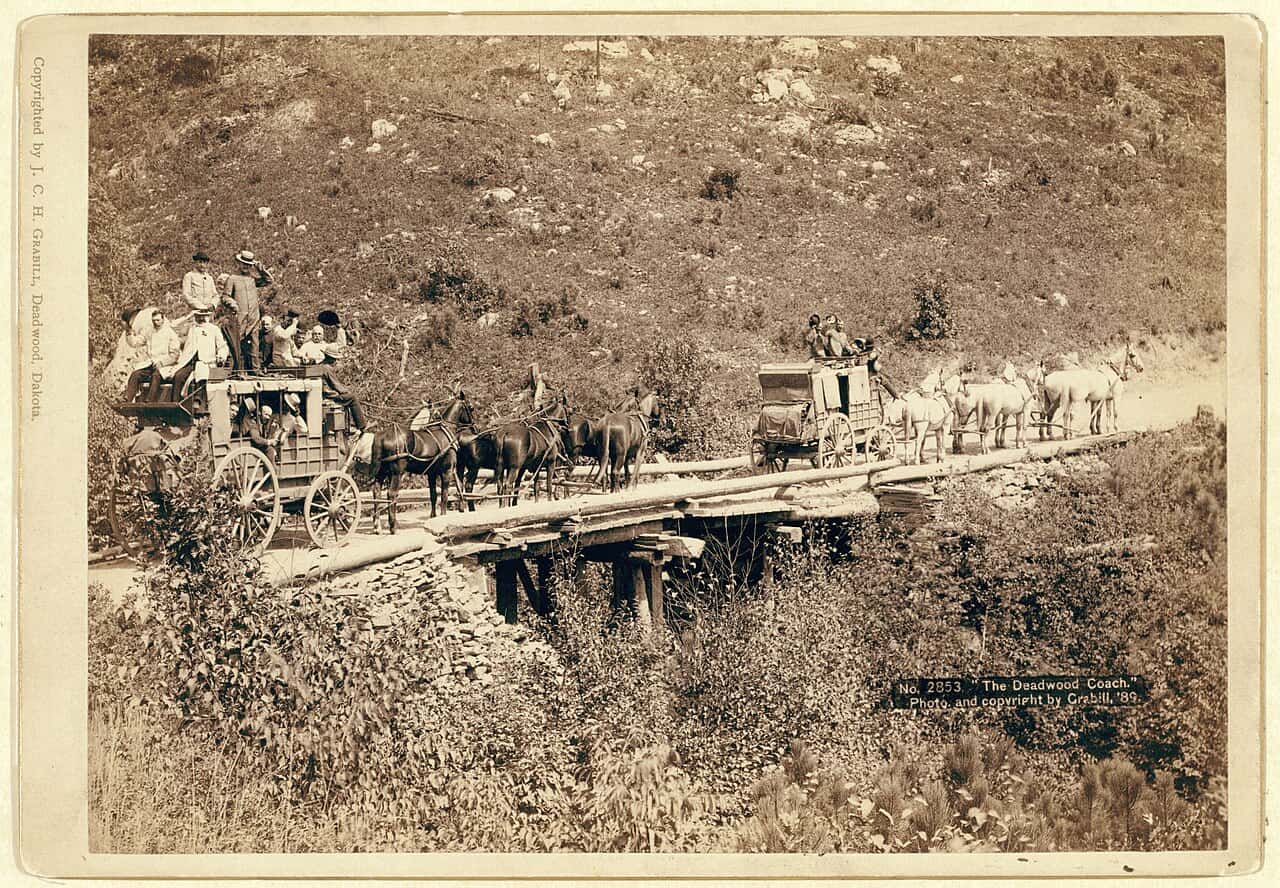
The last stagecoach robbery ever committed east of the Mississippi did not happen in some western territory. It happened in the U.P., on August 26, 1889, on the wagon road to Lake Gogebic. A 22-year-old bandit stepped out in front of the stage with a revolver in each hand and gave the politest stickup line in outlaw history: Donate. I’m collecting.

The Black Bart of the U.P.
His name was Reimund Holzhey, a young German immigrant who had read too many dime novels. He borrowed his alias from Black Bart, the famous California highwayman, and spent the summer of 1889 robbing trains and stages across the western U.P. and northern Wisconsin. For about five months, people in the Gogebic iron country were genuinely afraid to travel by road.
Here is the detail the nickname hides. The real Black Bart, in all his celebrated holdups, never shot a single person. The U.P.’s version did.
The Gogebic stage
The coach he stopped that August morning carried Illinois bankers heading to the resort hotel on Lake Gogebic for a summer holiday. One passenger pretended to reach for his valuables and pulled a gun instead. In the shootout that followed, a banker named Adolph Fleischbein was hit and fell from the fleeing stage.
Holzhey walked up, took the wounded man’s pocketbook, gold watch, a ten dollar gold piece, and a five dollar bill, and vanished into the woods. Help did not reach Fleischbein for two hours. He died the next day in Bessemer, and a robbery became a murder.

Caught over a cribbage game
Rewards piled past a thousand dollars. Bloodhounds and an Ojibwe tracker followed him north and lost the trail, because Holzhey had doubled back east toward Marquette County. Four days after the robbery he walked into a hotel in the little town of Republic and asked for a room under the name Henry Plant.
The hotel’s owner, a former detective named William O’Brien, was playing cribbage in the lobby. He recognized the stranger from a newspaper sketch, quietly sent for the deputy sheriff and the night marshal, and Holzhey was taken the next morning without ever getting off a shot. The engraved pocketbook in his coat, with Fleischbein’s name on it, settled the question. Before shipping him to trial, the locals posed the outlaw for a photograph, sitting stiffly between his captors in front of a painted parlor backdrop.
The strangest redemption in Michigan history
Convicted of murder that fall, Holzhey went to Marquette Branch Prison for life, and for years he was the worst inmate in the place. He attempted escapes, took hostages, and staged hunger strikes, all while suffering blackouts and seizures traced to a childhood skull fracture. In 1893 he was transferred downstate for treatment, and whatever the doctors did, the man who came back was somebody else.
The former terror of the Gogebic Range taught himself photography, ran the prison library, and edited the prison newspaper. The warden himself lobbied the governor, who commuted the sentence in 1910, and in 1913, after 24 years, Holzhey walked free, reportedly having stayed up all night waiting for the sunrise. He spent his last decades as a wilderness guide and photographer, selling scenic pictures to tourists at northern resorts and later at Yellowstone, and died quietly in Florida in 1952.
The West got the legends, the movies, and the folk songs. The U.P. got the real thing, last of his kind on this side of the river, caught by a hotel keeper over a cribbage board.
More worth reading


Yooper Hub community
The conversation
Know something this story missed? Corrections and additions get read by an editor and folded into the article, with credit.
Real neighbors, real names. A Yooper Hub editor reads your first comment before it appears; after that you’re a known neighbor and your comments post right away. No account required. Community guidelines
Nothing here yet. A sentence is plenty: a correction, a name, or what you remember about this place.
Sources, credits, and reporting details
Sources & accountability
How this story was reported
Editorial methodArchival synthesis
Last verifiedJul. 13, 2026
Corrections statusNo material correction identified in the July 13, 2026 source review.
AI assistanceResearched and drafted with AI tools. Reviewed and approved by editor Keegan O’Brien.
Verification note: CEO-directed review checked the central claims against 1 direct public evidence link on July 13, 2026. No material correction was identified.
Primary sources
-
Direct evidence for: The Last Stagecoach Robbery East of the Mississippi Happened in the U.P. — Michiganology
Accessed Jul. 13, 2026.
Direct public evidence reviewed against the article on July 13, 2026.
Photo and media credits
-
stagecoach-1889-grabill — Creator or rights holder named in the WordPress attachment caption
Featured image record. Accessed Jul. 13, 2026. public domain.
Supports: Featured image used by this article.
A stagecoach photographed by John C.H. Grabill in 1889, the same year Holzhey stopped the Gogebic stage. Photo: Library of Congress / public domain.