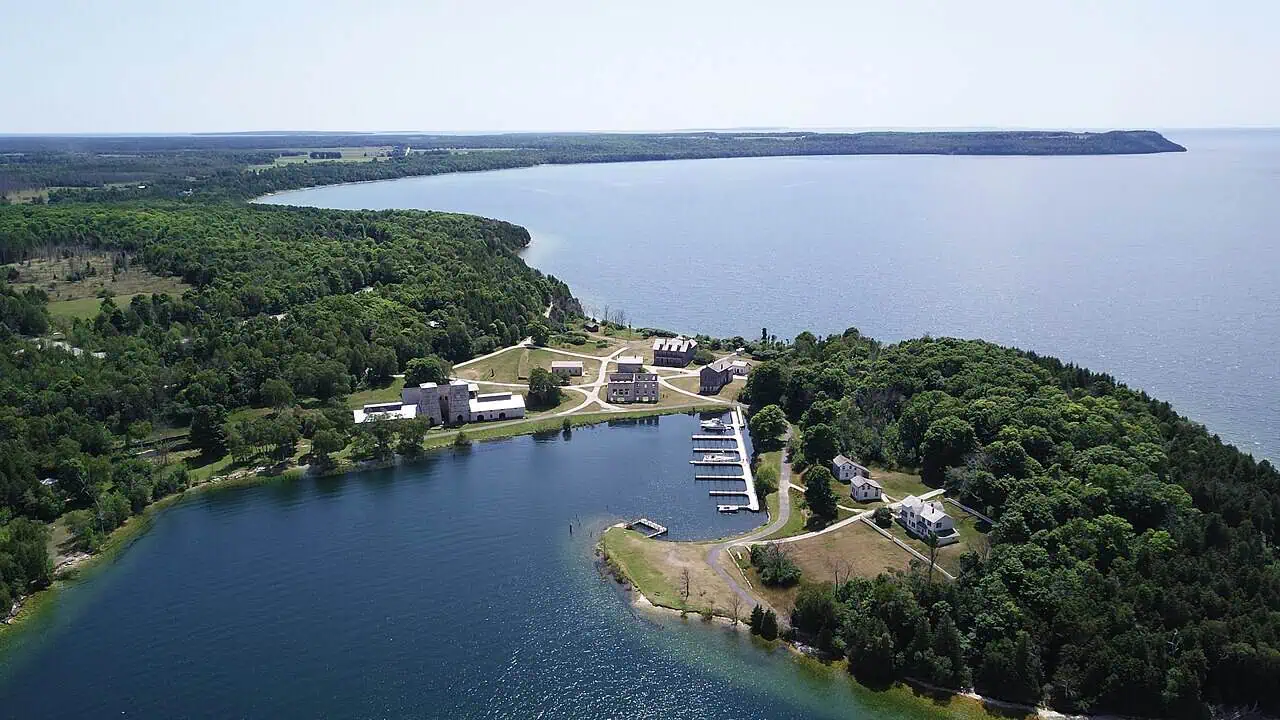
On the Garden Peninsula, at the end of a dead-end road along Big Bay de Noc, sits an entire 19th-century town that everybody walked away from in 1891. More than twenty original buildings still stand. Dishes still sit on tables in the workers’ houses. And inside the great stone blast furnaces, the charcoal loaded for the next burn is still sitting there, exactly where the last shift left it 134 years ago.

Built to feed America iron
Fayette existed for one reason. In 1867, Fayette Brown of the Jackson Iron Company looked at Snail Shell Harbor and saw a perfect machine: white limestone cliffs to purify molten iron, endless hardwood forest to burn into charcoal, and a deep, sheltered harbor to ship the finished product. The company built a whole town on the spot and named it after him.
For 24 years the twin furnaces roared at around 3,000 degrees while some 500 people, most of them immigrants from Canada, the British Isles, and Scandinavia, lived in the company’s neat grid of houses. Fayette turned out 229,288 tons of pig iron, some of the finest in the country, shipped south to be rolled into the rails and girders that were building America.
Passage source: Michigan History Center, Fayette Historic Townsite.
The town that ate itself
What killed Fayette was Fayette. The furnaces devoured the forest, some 16,000 acres of hardwood cut and smoldered into charcoal, until the Garden Peninsula around the town was stripped bare. A major fire in 1883 wounded the operation, and newer, cheaper ways of making iron and steel were making charcoal smelting obsolete anyway.
In 1891 the Jackson Iron Company simply shut it off. With no furnace there was no town, and the population of 500 scattered almost overnight, leaving about 20 souls to fish and farm among the empty buildings. For a few decades the pretty harbor limped along as a resort and fishing village. Then even that faded, and Fayette just stood there, waiting.
Passage source: Michigan DNR, Fayette Historic State Park General Management Plan.

Frozen in 1891
That accidental waiting is why Fayette is now considered one of the best-preserved company towns in America. The State of Michigan bought the site in 1959 and has spent decades stabilizing rather than rebuilding it, so what you walk through is overwhelmingly the real thing: the hotel, the opera house, the company office, the machine shop, the superintendent’s house on its rise, the furnace complex against the cliffs.
The effect is genuinely eerie in the best way. This is not a ghost town of crumbled foundations and a historical marker. It is a whole functioning place with the people removed, a U.P. Pompeii where the disaster was simply economics.
Go stand in it
Fayette Historic State Park sits 17 miles down M-183 from US-2, and it earns the detour. The townsite buildings are open roughly mid-May through mid-October, the grounds year-round with a Recreation Passport. Kayakers say the limestone cliffs over that clear green harbor rival Pictured Rocks, and across the water grow ancient cedars up to 1,900 years old, the oldest trees in any Michigan state park.
Walk the slag beach where the furnace waste still glitters, climb the bluff trail for the postcard view down onto the town, and give yourself at least two hours. October, when the hardwoods that grew back turn red and gold over the empty streets, might be the single most cinematic sight in the U.P.
The U.P. keeps its receipts. The Kingston Plains kept the stumps, and Fayette kept the whole town, right down to the charcoal waiting in the furnaces for a shift that never came back.
Sources, credits, and reporting details
Sources & accountability
How this story was reported
Source review complete. This ledger passed Yooper’s publishing standard and matches the current article.
Editorial methodArchival synthesis
Image provenanceNo AI-generated imagery declared
Accountable reviewerKeegan O'Brien
Last verifiedJul. 10, 2026
Verification note: Historical claims and current visitor information were checked against Michigan DNR, Michigan History Center, and regional heritage sources. Photo credits were matched to their original Wikimedia Commons file pages.
Primary sources
-
Fayette Historic Townsite — Michigan History Center / Michigan DNR
Accessed Jul. 10, 2026.
-
Fayette Historic State Park General Management Plan — Michigan Department of Natural Resources
Accessed Jul. 10, 2026.
-
Fayette Historic State Park visitor information — Michigan Department of Natural Resources
Accessed Jul. 10, 2026.
Additional reporting
-
Fayette — Ghost Towns of the Upper Peninsula — Beaumier U.P. Heritage Center, Northern Michigan University
Accessed Jul. 10, 2026.
-
Fayette Historic State Park & Townsite — Visit Escanaba
Accessed Jul. 10, 2026.
Supports: Regional visitor context and an overview of why Fayette Brown chose Snail Shell Harbor.
-
Fayette Historic State Park — Wikipedia contributors
Accessed Jul. 10, 2026.
Supports: Background chronology and links to further references.
Used as a discovery and cross-checking source, not as the sole authority for consequential claims.
Photo and media credits
-
Snail Shell Harbor at Fayette — AaronJoePick / Wikimedia Commons
Published Aug. 6, 2016. Accessed Jul. 10, 2026. CC BY-SA 4.0.
-
Blast furnace complex across Snail Shell Harbor — AaronJoePick / Wikimedia Commons
Published Aug. 6, 2016. Accessed Jul. 10, 2026. CC BY-SA 4.0.

