The plan for closing the Eagle Mine on the Yellow Dog Plains is to let it fill with water, then watch it for twenty years. That is not a worst case. It is written into the permit as a numbered condition.
Almost everything published about this mine right now is out of date, including the page the State of Michigan maintains about it.
Three things the coverage still gets wrong
The mine changed hands. Talon Metals completed its acquisition from Lundin Mining on January 9, 2026, paying in stock, roughly 275 million Talon shares. Eagle Mine general manager Darby Stacey became Talon’s chief executive.
Eight months later, Michigan EGLE’s own nonferrous mining page still describes Eagle Mine LLC as a subsidiary of Lundin Mining. The regulator’s public file has not caught up with the regulated company.
The mine also got three more years. Coverage still says it winds down around 2027, and that was true until Talon’s technical report, effective February 28, 2026 and released that April, replaced the 2027 mine plan with a reserve-backed plan running into the second half of 2030. The extension leans on the Keel deposit alongside Eagle and Eagle East.

And the superlative needs two qualifiers
Eagle is very widely called the only primary nickel mine in the United States. That is the company’s claim, not a federal finding.
The USGS Mineral Commodity Summaries for both 2025 and 2026 decline to say it, referring only to “the underground Eagle Mine in Michigan” and noting that nickel is still recovered domestically as a byproduct of copper and platinum-group-metals processing.
Talon’s own phrasing is the careful one: the only primary nickel mine currently operating in the United States. Primary meaning nickel is the point rather than a byproduct. Drop either qualifier and the claim fails.
What actually happens to the Plains
This is the section nobody writes, and it is all sitting in permit MP 01 2007, amended November 19, 2025.
Stopes are backfilled as mining moves through them, cemented aggregate in the primary stopes and limestone-amended development rock in the secondary ones. Then the workings are allowed to reflood.
Condition L42 then requires postclosure monitoring for twenty years after reflooding and surface reclamation finish. Condition M1 keeps the wastewater treatment plant standing for five of those years, and if monitoring suggests fluids are migrating upward, the operator has to pump, treat and recirculate water out of the upper bedrock workings. Condition L45 holds quarterly water monitoring at eight stations, six of them on the Salmon Trout River. Financial assurance is set at $17 million.
One thing the permit does not do is name a post-mining land use. There is no designation as recreation, industry or natural area. Reclamation is defined as stabilizing, revegetating and monitoring, and nothing beyond that.

The river is the thing being watched
The Salmon Trout holds what Michigan Tech’s Casey Huckins describes as the last known remnant breeding population of coaster brook trout in the area, only a few hundred adults running up to spawn each fall. The careful wording matters; it is regularly flattened into a claim that fails.
Eagle’s 2025 annual report to EGLE shows brook trout still present, with a June survey taking 170 fish across nine stations and habitat rated excellent to good. It also reports sodium and chloride exceedances at monitoring well QAL024A dating to 2013, which the operator attributes to historic road salt use at the site.
Eagle Rock
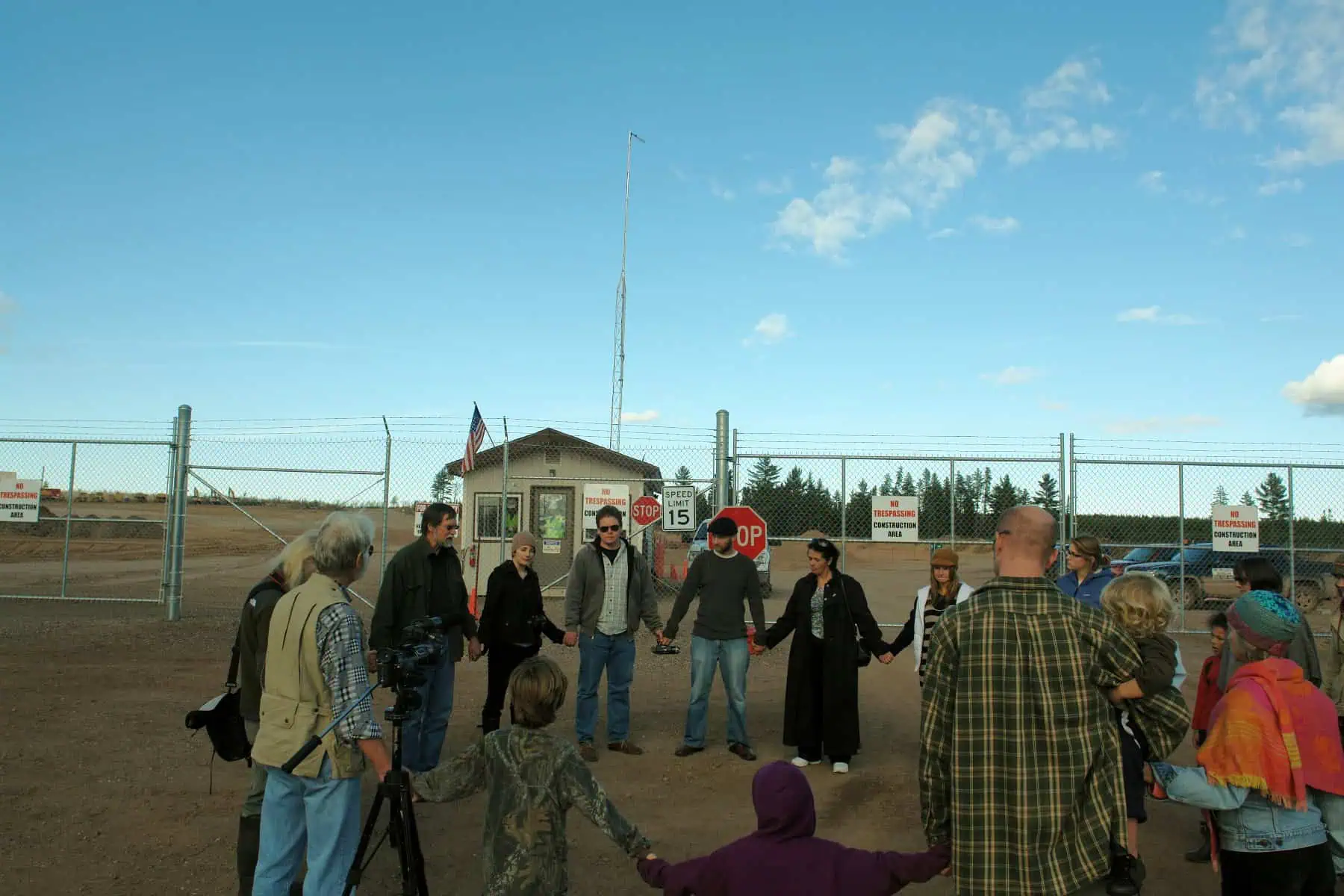
The portal was driven through Eagle Rock, Migi zii wa sin, over the objection of the Keweenaw Bay Indian Community. In a February 2008 letter to the EPA, KBIC Tribal Historic Preservation Office officer Summer Cohen wrote of “much concern over the fate of the Yellow Dog Plains and especially the place called Migi zii wa sin,” and that the project would significantly impact lands subject to the Community’s treaty rights.
The legal question turned on whether Eagle Rock was a place of worship under Part 632. The administrative law judge, Richard Patterson, found in August 2009 that the state had not properly addressed the rock and recommended moving the portal. In January 2010 the DEQ’s final decision, signed by senior policy adviser Frank Ruswick, overruled him: a place of worship, in the department’s reading, had to be a building. The Court of Appeals affirmed in August 2014, with more than 500 KBIC members present at argument.
What the permit says will happen to the outcrop at closure is not something we could find. That question is with EGLE.
More worth reading


Sources, credits, and reporting details
Sources & accountability
How this story was reported
Editorial methodAggregation
Last verifiedSep. 9, 2026
Corrections statusNo material correction note is recorded on this article.
AI assistanceResearched and drafted with AI tools. Reviewed and approved by editor Keegan O’Brien.
Verification note: The ledger establishes the Jan 9, 2026 Talon acquisition and share consideration, EGLE's stale 'subsidiary of Lundin Mining' wording, the Feb 28, 2026 technical report extending the mine plan to H2 2030, the USGS MCS 2025/2026 wording that omits 'only primary nickel mine', the closure conditions in permit MP 01 2007 (20-year postclosure monitoring, 5-year WWTP retention, $17M financial assurance, no designated post-mining land use), the 2025 aquatic survey and QAL024A road-salt exceedance, and the Aug 2014 Court of Appeals affirmance. The article does not claim the mine is the only U.S. nickel mine without qualifiers, and does not state what happens to Eagle Rock at closure.
Primary sources
-
Talon Metals Completes Previously Announced Acquisition of Lundin Mining's Eagle Mine and Humboldt Mill Operations — Talon Metals Corp.
Published Jan. 9, 2026. Accessed Sep. 9, 2026.
-
Talon Metals Announces Eagle Mine NI 43-101 Technical Report Results; Provides Highlights and Strategic Takeaways — Talon Metals Corp.
Published Apr. 30, 2026. Accessed Sep. 9, 2026.
-
Nonferrous metallic mining (project status page) — Michigan Department of Environment, Great Lakes, and Energy (EGLE)
Accessed Sep. 9, 2026.
Page shows no date.
-
Eagle Project Mining Permit MP 01 2007 (amended, posted 2025-11-19) — Michigan EGLE, Geologic Resources Management Division
Published Nov. 19, 2025. Accessed Sep. 9, 2026.
Document header shows 'Date Issued: December 14, 2007'; the Nov 19, 2025 amendment date is from EGLE's file name and page listing. The 2025 annual report references a paste-backfill amendment approved 05/30/25. Fetch of the ?rev= URL returned proxy 403; the bare URL fetched.
-
Eagle Mine 2025 Annual Mining and Reclamation Report, Part 1 (MP 01 2007) — Eagle Mine LLC, filed with Michigan EGLE
Published Mar. 12, 2026. Accessed Sep. 9, 2026.
Report dated March 12, 2026, revised 05/05/26.
-
Eagle Mine 2025 Annual Report, Part 4, Appendix R: Aquatic Survey Report — Eagle Mine LLC, filed with Michigan EGLE
Published Mar. 12, 2026. Accessed Sep. 9, 2026.
-
Mineral Commodity Summaries 2026: Nickel — U.S. Geological Survey
Published Feb. 1, 2026. Accessed Sep. 9, 2026.
Document footer says February 2026; exact day not shown.
-
Mineral Commodity Summaries 2025: Nickel — U.S. Geological Survey
Published Jan. 1, 2025. Accessed Sep. 9, 2026.
Footer says January 2025; exact day not shown.
-
National Wildlife Federation v. Department of Environmental Quality, No. 308366 (Mich. Ct. App. Aug. 12, 2014) — Michigan Court of Appeals, via Justia
Published Aug. 12, 2014. Accessed Sep. 9, 2026.
This published opinion covers the groundwater discharge permit; the Eagle Rock 'place of worship' discussion is in companion docket 307602 (mining permit), which could not be fetched. See unresolved.
Additional reporting
-
Dept. rules against native rights, says Eagle Rock isn't sacred — Intercontinental Cry (IC Magazine)
Accessed Sep. 9, 2026.
Reports the Yellow Dog Watershed Preserve's account of the DEQ reasoning. Used for the corrected Eagle Rock sentence (Sept 9 2026).
-
Mine opponents find both good and bad in judge's decision — Save the Wild U.P.
Published Aug. 18, 2009. Accessed Sep. 9, 2026.
-
Michigan Court of Appeals Affirms Eagle Mine's Permits — Yellow Dog Watershed Preserve
Published Aug. 15, 2014. Accessed Sep. 9, 2026.
Turtle Talk (KBIC press release, 2014-06-05, https://turtletalk.blog/tag/kennecott-eagle-mine/) states the MDEQ final permit decision asserted 'only built structures are places of worship' after ALJ Richard Patterson recommended mitigation.
-
Save a Spawning Site for Coaster Brook Trout — Michigan Technological University, Biological Sciences
Published Apr. 3, 2013. Accessed Sep. 9, 2026.
Photo and media credits
-
Lois Gibbs Sacred Eagle Rock Big Bay, MI 10-15-10 (38).JPG (featured image) — Yoopernewsman, via Wikimedia Commons
Featured image record. Published Oct. 15, 2010. Accessed Sep. 9, 2026. CC BY-SA 3.0.
Matched visually against the uploaded file: this is frame (38) of the series, the circle at the gate. Commons file identified Sept 9 2026 via the Commons API from the author credit and matching aspect ratio.
.JPG)