On the morning of November 3, 1926, fifty-two men were underground at the Barnes-Hecker iron mine west of Ishpeming. At 11:20 a routine blast went off. Within about fifteen minutes the entire mine, more than a thousand feet deep, was full of water, mud, and quicksand. Fifty-one men died. One man outran it, straight up.

A mine under a swamp
The Barnes-Hecker worked a rich arm of the Marquette Iron Range near North Lake, and everyone knew it was a wet mine. Part of the ore body ran beneath waterlogged swampland, and the ground above the workings was soft glacial drift rather than solid rock. Cleveland-Cliffs had engineered it to be as safe as the era allowed.
That morning’s blast, for reasons no one survived to explain, cracked the ceiling of a stope open to that soft ground. The swamp above poured in. On the surface, onlookers watched a pit 300 feet long open up and swallow the landscape as the swamp above drained into the mine like a pulled bathtub plug.
Fifteen minutes
Down on the second level, a 23-year-old tram motorman named Wilfred Wills felt a blast of air snuff out his light and heard the rumble every miner dreaded. He shouted a warning and ran for the shaft with three other men, Jack Hanna, Joseph Mankee, and Thomas Kirby Jr. The hoist was already gone. They started up the ladders.
Wills climbed roughly 800 feet with the flood rising under him, at times to his waist. The three men climbing below him were overtaken and never made it out. He came out of the shaft collar into the daylight alone. The water stopped rising about 185 feet below the surface. Of the fifty-one men still down there, among them the mine captain and County Mine Inspector William E. Hill, who had been re-elected to his job only the day before, none came up alive.

The mine became the grave
Rescue was impossible almost immediately, and even recovery proved too dangerous. Pumping was attempted and abandoned, and search parties working in through the connected North Lake mine were driven back. Only ten of the dead were ever brought out. The remaining forty-one men were left where they lay, and the flooded shaft was permanently sealed above them. The Barnes-Hecker never operated again. It remains the worst industrial disaster in Michigan history.
The human arithmetic was staggering for a community the size of Ishpeming. Many of the dead were Finnish immigrants and their sons, and the disaster left 42 widows and 132 children without fathers. The law of 1926 required nothing of Cleveland-Cliffs, which voluntarily paid the families double workers’ compensation. Wills, the only survivor, carried the day with him for the remaining 46 years of his life, in an era before anyone had a name for that kind of wound. Members of his own extended family were among the men who never came up.
Remembering them
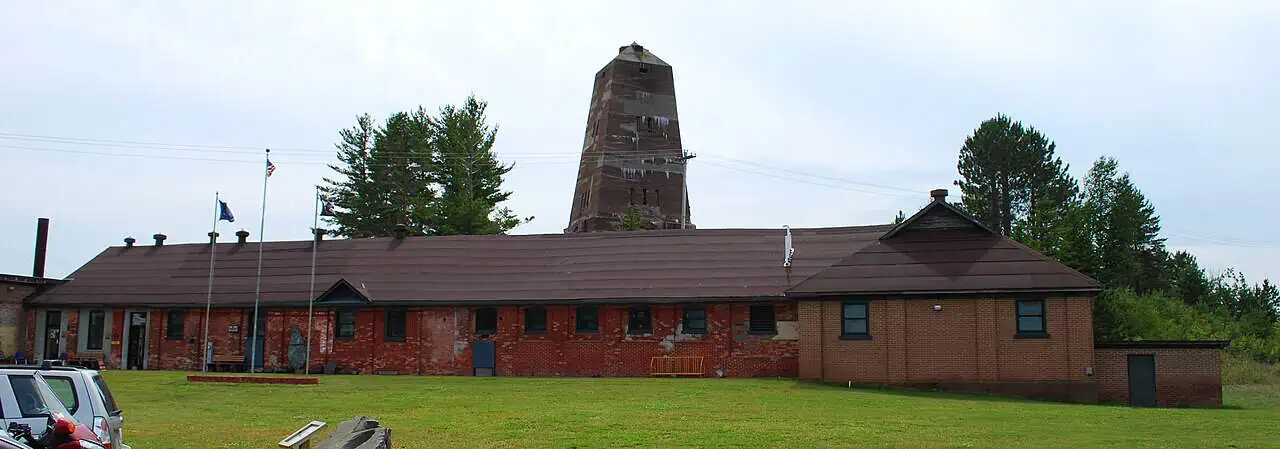
The site of the Barnes-Hecker sits quiet today off County Road 496 near North Lake, marked by a memorial stone raised by Ely Township in 1971 and a state historical marker. A plaque at the Cliffs Shaft Mine Museum in Ishpeming carries all fifty-one names, and the museum’s great headframes are the best place to stand and understand the world these men worked in. Every November 3, people from the mining towns still stop to read the names.
The U.P. was built on iron, and iron had a price. The Barnes-Hecker is where the Marquette Range paid the most of it in a single morning, and one young man’s climb up 800 feet of ladder is the only reason anyone lived to describe it.
Correction: An earlier version of this article said the mine ran beneath a lake and that divers took part in the recovery. Neither is right. The flood came from the waterlogged swamp and glacial ground above the workings, and no divers were involved. We have also corrected the number of men underground and the count of families left behind. Our thanks to the readers and the Barnes-Hecker remembrance community who set the record straight. For the definitive account, see Mary V. Tippett’s book Enduring Legacies: People of the 1926 Barnes-Hecker Mine Disaster.
Sources, credits, and reporting details
Sources & accountability
How this story was reported
Legacy source review pending. This published article has not yet passed Yooper’s current source-readiness gate.
Editorial methodNot yet classified
Image provenanceAI imagery status not yet declared
Accountable reviewerNot yet assigned
Last verifiedNot yet recorded
Next required reviewNot yet scheduled
Sources: the U.S. Bureau of Mines report on the disaster, the Marquette Mining Journal of November 1926, the Mining History Journal (Robert M. Neil, 2008), the Michigan historical marker at the site, and Mary V. Tippett’s book Enduring Legacies: People of the 1926 Barnes-Hecker Mine Disaster (2025).
Direct links, claim-level support, dates, credits, and editorial accountability may still be incomplete.