Just outside the main door of the Michigan Iron Industry Museum in Negaunee, a marker tells how Marji-Gesick, a Chippewa chief, was hired in 1845 to find an iron ore deposit about three miles away and was paid with a certificate entitling him to stock in the company. After his death his daughter, Charlotte Kawbawgam, found that certificate. When the Jackson Iron Company refused to recognize her, she took it to court and won.
The marker, put up in 1992 by the State Bar of Michigan and the Marquette County Bar Association, says the Michigan Supreme Court found that her parents’ marriage “was valid under Chippewa law” and so had to be recognized by Michigan’s courts. She was declared his lawful heir. The marker says the story was immortalized in Laughing Whitefish, a book by former Michigan Supreme Court justice John Voelker under his pen name, Robert Traver.

The forge under the museum
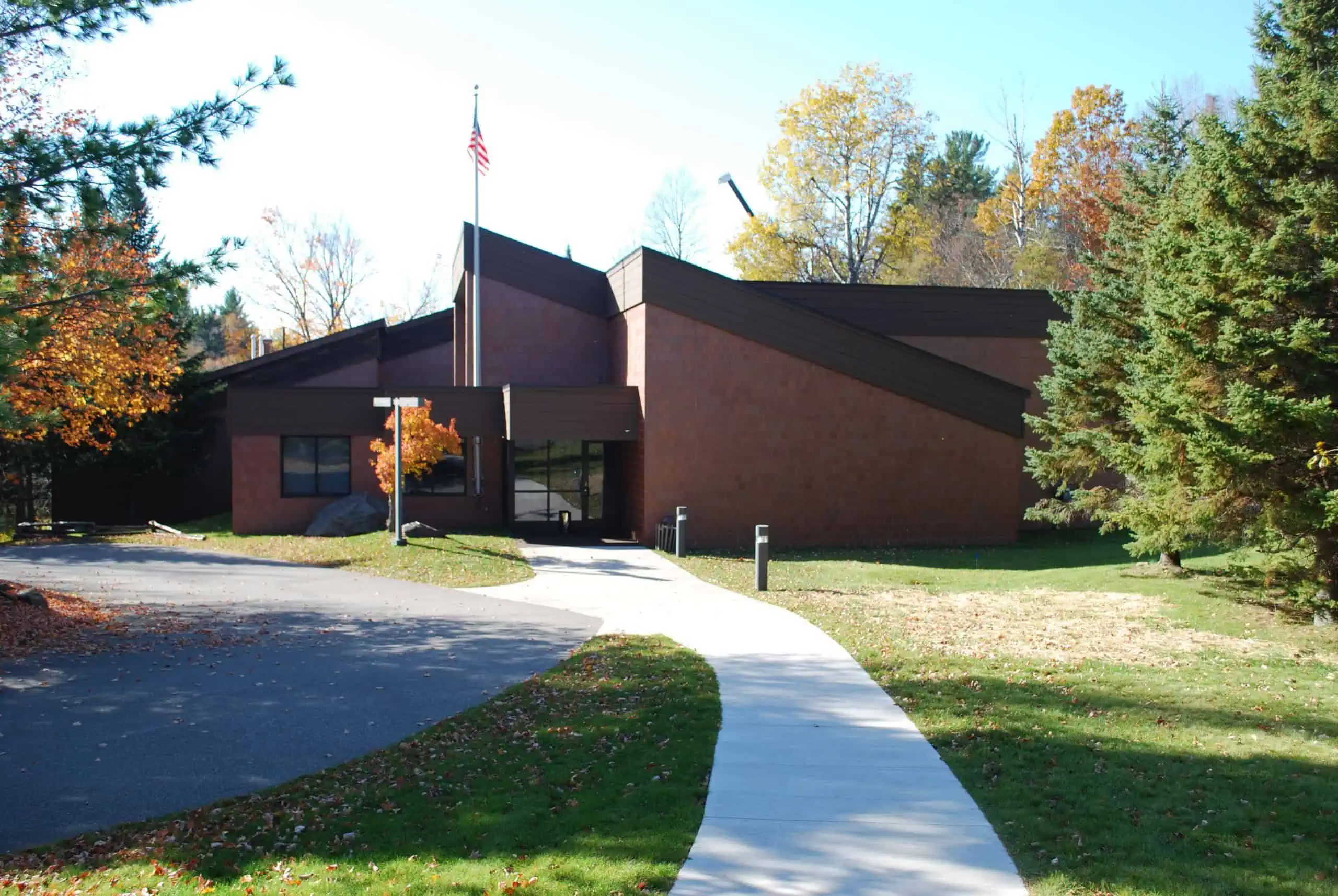
The museum overlooks the Carp River and what the Michigan History Center calls “the site of the first iron manufactory in the Lake Superior region.” The Jackson company’s forge made its first iron on Feb. 10, 1848, when forgemaster Ariel N. Barney turned out the first bloom, the DNR wrote in 2014. That March, by Wikipedia’s account, snowmelt carried away the dam and the forge sat idle until summer repairs.
Wikipedia’s entry also says the forge was “closed for good and abandoned in 1854.” The Michigan History Center, which runs the museum, says “The Jackson Iron Company and others manufactured wrought iron from local ore at this site from 1848-1855.” We are going with the people who run the site.
Built for $1.5 million, cracked by snow
Cleveland-Cliffs deeded a 40-acre tract including the forge site to the state, and the museum was built in 1985 and 1986 for $1.5 million and opened in 1987, the History Center says. It tells the story of Michigan’s three iron ranges through exhibits, outdoor trails and a film, Iron Spirits: Life on the Michigan Iron Range, shown in an 88-seat auditorium.

This year the snow got to it. Trusses over the main gallery began cracking on Feb. 21 under heavy, drifted snow, and on March 20 the DNR announced the museum was closed indefinitely. The crew that cleared the roof worked from a lift so as not to add weight, and museum historian Troy Henderson said the snow they removed ran 4 to 6 feet deep.
The History Center’s page now says the museum “reopened on Tuesday, June 2!” It says nothing about the roof repairs, so we cannot either.
Before you drive out
Admission is free, but a Recreation Passport is required for vehicles. The museum’s main page lists Tuesday through Sunday, 10 a.m. to 4 p.m., through Oct. 15 and does not say what follows. Its visitor page lists Wednesday through Saturday, 10 to 4, from October through April. Call 906-475-7857 before you go.
The History Center suggests allowing one to two hours, and the museum is a trailhead for the 47-mile Iron Ore Heritage Trail across the Marquette Iron Range.
Go See It
Michigan Iron Industry Museum, Negaunee
- Where
- 73 Forge Road, MI 49866. Take Jackson Trace Parkway off US-41, one mile west of the M-35 junction.
- Hours
- Main page: Tuesday to Sunday, 10 a.m. to 4 p.m., through Oct. 15. Visitor page: October 1 to April 30, Wednesday to Saturday, 10 a.m. to 4 p.m. Call to confirm.
- Cost
- Admission free. Recreation Passport required for vehicle entry.
- Season
- Open year-round on the visitor-page schedule; closed on state holidays and several other days October through April. Closed March 20, 2026 for roof damage; the History Center says it reopened June 2.
- Drive
- From Marquette: 17 min (9.1 mi) via US-41
From the Bridge: 2 hr 56 min (173 mi) via US-2 W and M-28 W
More worth reading


Yooper Hub community
The conversation
Know something this story missed? Corrections and additions get read by an editor and folded into the article, with credit.
Real neighbors, real names. A Yooper Hub editor reads your first comment before it appears; after that you’re a known neighbor and your comments post right away. No account required. Community guidelines
Nothing here yet. A sentence is plenty: a correction, a name, or what you remember about this place.
Sources, credits, and reporting details
Sources & accountability
How this story was reported
Editorial methodAggregation
Last verifiedOct. 5, 2026
Corrections statusNo material correction note is recorded on this article.
AI assistanceResearched and drafted with AI tools. Reviewed and approved by editor Keegan O’Brien.
Verification note: Sources read and checked Oct. 5, 2026.
Primary sources
-
Laughing Whitefish Historical Marker — State Bar of Michigan and Marquette County Bar Association (marker text via HMdb)
Accessed Oct. 5, 2026.
[Chrome] "Marji-Gesick a Chippewa chief was hired in 1845 to locate a valuable iron ore deposit about three miles from here. He was paid with a Certificate of Interest entitling him to stock in the company." / "After Marji-Gesick's death, his daughter, Charlotte Kawbawgam found the certificate. When the Jackson Iron Company refused to recognize her ownership interest, she took the company to court."
-
Laughing Whitefish Historical Marker — State Bar of Michigan (via HMdb)
Accessed Oct. 5, 2026.
Supports: Court outcome; heir; Voelker / Robert Traver; erected 1992; location at museum door
[Chrome] "The court concluded that since the marriage was valid under Chippewa law, it must be recognized by Michigan's courts. Charlotte Kawbawgam was declared Marji-Gesick's lawful heir" / "immortalized in Laughing Whitefish, a book authored by former Michigan Supreme Court justice John Voelker under his pen name, Robert Traver." / "Erected 1992 by the State Bar of Michigan and the Marquette County Bar Association." / "It is just outside the main door to the Michigan Iron Industry Museum, on the left." / "46 31.298 N, 87 33.858 W"
-
Michigan Iron Industry Museum — Michigan History Center
Accessed Oct. 5, 2026.
Supports: First iron manufactory in the Lake Superior region; three iron ranges; film in 88-seat auditorium
[Chrome] "overlooks the Carp River and the site of the first iron manufactory in the Lake Superior region. The museum tells the story of Michigan's three iron ranges" / "'Iron Spirits: Life on the Michigan Iron Range,' is shown six times daily in the museum's 88-seat auditorium."
-
Michigan Iron Industry Museum — Michigan History Center
Accessed Oct. 5, 2026.
Supports: Reopened June 2; Tue-Sun 10-4 through Oct 15; free; Recreation Passport; 1-2 hours; phone
[Chrome] "The Michigan Iron Industry Museum reopened on Tuesday, June 2! The museum is open Tuesdays through Sundays from 10 a.m. to 4 p.m. through Oct. 15." / "Allow one to two hours for your visit. Admission is free; however, a Recreation Passport is required for vehicle entry." / "Phone: 906-475-7857"
-
Michigan Iron Industry Museum Visitor Information — Michigan History Center
Published Mar. 8, 2023. Accessed Oct. 5, 2026.
[Chrome] "October 1 – April 30: Wednesday through Saturday, 10 a.m. to 4 p.m." / "closed on official state holidays and several other days" / "located eight miles west of Marquette. Take Jackson Trace Parkway … off of U.S. 41, one mile west of Junction M-35" / "The museum is a trail head for the Iron Ore Heritage Trail. It is a 47-mile, year round, multi-use, interpretive trail"
-
Explore (About the museum) — Michigan History Center
Accessed Oct. 5, 2026.
[Chrome] "The Jackson Iron Company and others manufactured wrought iron from local ore at this site from 1848-1855." / "Cleveland-Cliffs Iron Company deeded a 40-acre tract of land, including the forge site, to the State of Michigan" / "funded by the state at a cost of $1.5 million, built in 1985-86, and opened to the public in 1987."
-
Enjoy a snowshoe hike at Carp River Forge Historic Site Feb. 1 — Michigan DNR
Published Jan. 23, 2014. Accessed Oct. 5, 2026.
Supports: Feb 10, 1848, Barney hammered the first bloom
[reader] "On Feb. 10, 1848, Ariel N. Barney hammered the first bloom into bar iron at the Carp River Forge."
-
Michigan Iron Industry Museum closed due to roof damage — Michigan DNR
Published Mar. 20, 2026. Accessed Oct. 5, 2026.
Supports: Closed indefinitely; trusses cracking Feb 21; heavy snow and drifts; lift; 4 to 6 feet (Henderson)
[Chrome] "is closed indefinitely after heavy snow caused structural damage to its main gallery roof" / "several of the trusses that bear the roof's weight began cracking Saturday, Feb. 21" / "this season's heavy snow, combined with drifts caused by windy conditions" / "They did it all from a lift extended above the roof so as not to add additional weight. The depth of snow the crew removed ranged from 4 to 6 feet." (Troy Henderson, historian for the museum)
-
Google Maps directions, Marquette to Michigan Iron Industry Museum — Google Maps
Accessed Oct. 5, 2026.
Supports: Drive time from Marquette
Fastest route read live Oct 5, 2026: 17 min (9.1 mi) via US-41.
-
Google Maps directions, Mackinac Bridge to Michigan Iron Industry Museum — Google Maps
Accessed Oct. 5, 2026.
Supports: Drive time from Mackinac Bridge
Fastest route read live Oct 5, 2026: 2 hr 56 min (173 mi) via US-2 W and M-28 W.
Additional reporting
-
Carp River Forge — Wikipedia
Accessed Oct. 5, 2026.
[Chrome] "the forge was closed for good and abandoned in 1854" / "the first iron was made on February 10, 1848, by forgemaster Ariel N. Barney" / "in March, a wave of snowmelt carried away the dam on the river, and the forge remained idle until repairs were made in the summer."
Photo and media credits
-
Michigan Iron Industry Museum.jpg (media 4125) — Wikimedia Commons / Andrew Jameson
Featured image record. Accessed Oct. 5, 2026. CC BY-SA 4.0.
Supports: Image credit and licence.
Commons file page metadata read Oct 5, 2026: licence CC BY-SA 4.0, author Andrew Jameson. Original 3872×2592; uploaded 2560×1714 (not cropped; downscaled only if wider than 2560). Viewed before alt text was written.
-
Jackson Iron Company SiteNegaunee MI A.jpg (media 4126) — Wikimedia Commons / Andrew Jameson
Accessed Oct. 5, 2026. CC BY-SA 3.0.
Supports: Image credit and licence.
Commons file page metadata read Oct 5, 2026: licence CC BY-SA 3.0, author Andrew Jameson. Original 3872×2592; uploaded 2560×1714 (not cropped; downscaled only if wider than 2560). Viewed before alt text was written.
-
Jackson Mine 1860.jpg (media 4124) — Wikimedia Commons / Central Upper Peninsula and Northern Michigan University Archives (Recorded in Stone)
Accessed Oct. 5, 2026. Public domain.
Supports: Image credit and licence.
Commons file page metadata read Oct 5, 2026: licence Public domain, author Central Upper Peninsula and Northern Michigan University Archives (Recorded in Stone). Original 1066×841; uploaded 1066×841 (not cropped; downscaled only if wider than 2560). Viewed before alt text was written.


