If you have been thinking about burning a brush pile, lighting a bonfire, or torching that winter’s worth of yard waste this week, the Michigan DNR has a blunt message for you. Put the matches down.
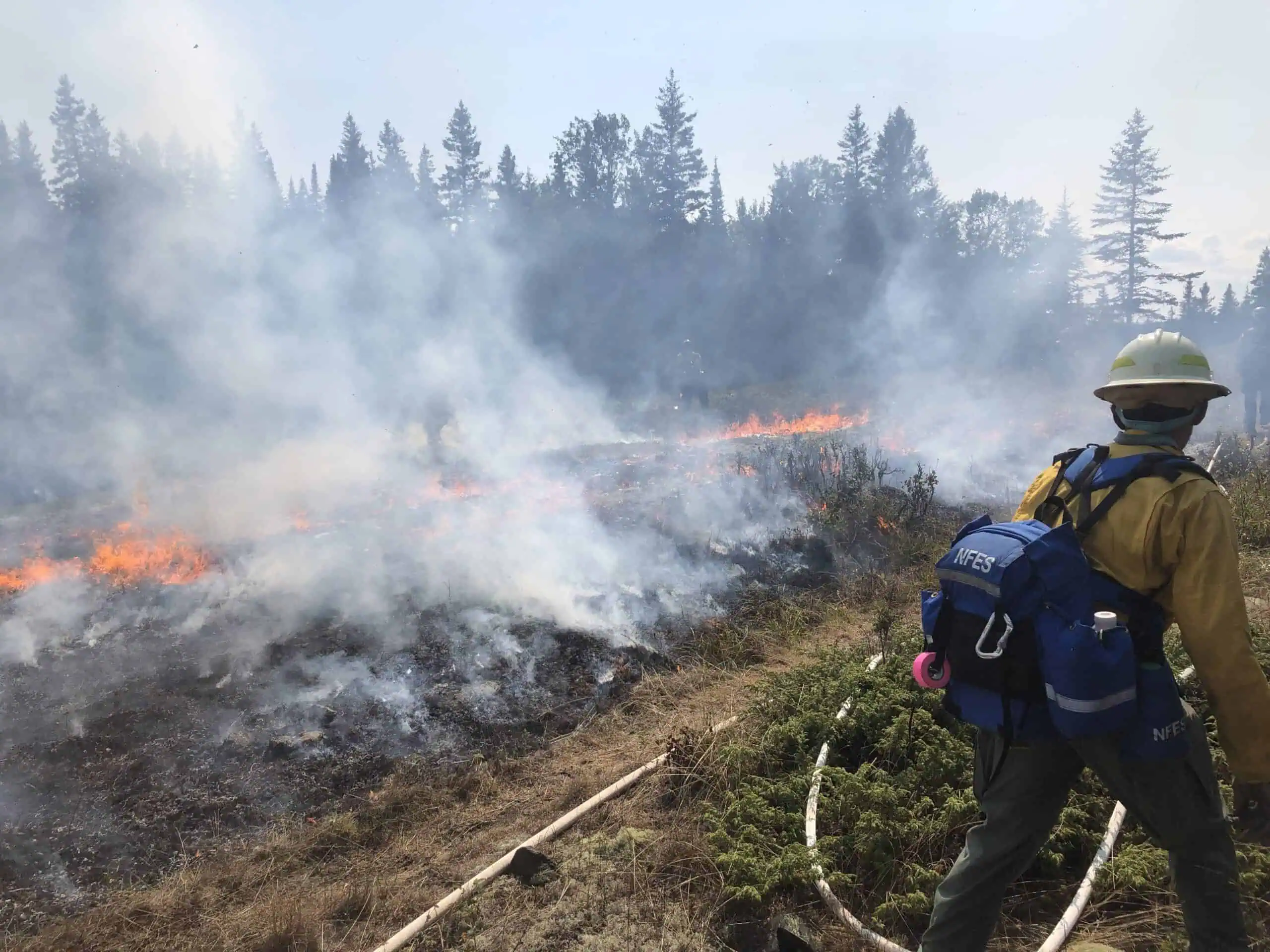
Much of the Upper Peninsula is sitting under an extreme fire danger rating right now, the highest level the state uses, and it is not a theoretical warning. Crews have already been out fighting flames. On Tuesday, the DNR and the U.S. Forest Service responded to multiple small fires along Forest Highway 13 in the Hiawatha National Forest, in Delta County between County Roads 440 and 442. A separate report of smoke came in from the Stonington Peninsula the same day.
The fires were knocked down fast, but the conditions that started them have not gone anywhere.
What is happening on the ground
The Hiawatha fires stayed small thanks to a quick, all-hands response. Local fire departments, the Forest Service, and the Shingleton DNR all rushed to the scene, and crews used both a helicopter and a fixed-wing aircraft to drop water on the flames.
“Luckily, we were able to get on them quite quickly. And they remained small, but a lot of local fire departments ran to that,” said Keith Murphy, a DNR Fire Management Specialist and spokesperson for the Upper Peninsula region.
Here is the part worth paying attention to. Even though the fires are contained, officials do not consider them completely out, and the cause is still unknown. In conditions like these, a fire that looks finished can find new life with a single gust of wind.
Why this dry spell is so dangerous
A warm, dry airmass has been parked over Upper Michigan since the start of June, with daytime highs climbing into the 80s, humidity dropping into the 20s and 30s, and gusty winds doing the rest of the work. That combination turns the forest into a tinderbox.
What makes this stretch especially tricky is that even the green stuff will burn. Murphy says both dry and green fuel types are highly flammable right now because the region simply has not seen any measurable rain.
“We’re pretty concerned about those higher wind gusts today. And if there was some sort of start in the pine fuel types, we could have a large fire, easily,” Murphy said.
It is not just a U.P. problem either. The DNR rated fire danger as extreme across the majority of the Upper Peninsula and very high across the northern Lower Peninsula this week, and closed burn permits statewide for the north until the region gets enough rain to bring the danger down. Northern Michigan has already lost real acreage this season. The Mapes Fire burned about 124 acres west of Mio in Oscoda County, and the Tomahawk Lake Fire scorched roughly 190 acres in Presque Isle County, both fueled by bone-dry conditions and downed wood left behind by the March 2025 ice storm in the northern Lower Peninsula.
Most of these fires are on us
Here is the number that should stick with every Yooper this summer. According to the Michigan DNR, nine out of ten wildfires in the state are caused by people, not lightning.
That means the things that spark them are ordinary, everyday activities. Burning yard waste on the wrong day. A campfire that was not fully put out. Sparks from power equipment or an off road vehicle in dry grass. A trailer chain dragging on the pavement. Parking hot equipment on a patch of dry lawn. Any one of those can be the start of something that gets away from you in seconds.
The good news in that statistic is the flip side of it. If people are the cause of nine out of ten fires, then people can prevent nine out of ten fires.
What it means for your summer plans
If you are heading out to camp, the rules have tightened. Open burning is banned across the entire Upper Peninsula right now. Small campfires for cooking are still allowed, but they need to be contained in a pit or ring and completely extinguished before you walk away.
Plenty of local campgrounds are going further than that on their own. At Whispering Valley RV Park in Rapid River, groundskeeper Ian Loper says they are not taking chances.
“Here at Whispering Valley campground, we never allow open burning. And with the information from the DNR, we are promoting the fact that we should not be burning whatsoever within the campground for this season,” Loper said.
A simple fire safety checklist
The DNR put out a short list of habits that make a real difference when the woods are this dry. Run through it before you light anything.
Keep a hose or another water source within reach any time you have a fire going. Make sure trailer chains are not dragging on the road, and never park hot equipment on dry grass. Keep campfires inside a ring or pit, and when you are done, douse the fire with water, stir the ashes, and douse it again. Never leave a fire or hot coals unattended, not even for a few minutes. Never shoot fireworks into the woods, dry grass, or shrubs. And skip the burn barrel for anything other than approved natural materials like paper and leaves, with a screen on top.
If you see a fire, call first
If a backyard fire gets away from you, or you spot flames or heavy smoke out in the woods, call 911 immediately. Do not try to put it out yourself before you call. Those first few minutes are the difference between a small fire and a large one.
One more thing worth repeating, because it has become a real problem at wildfire scenes. Do not fly a drone anywhere near an active fire. The Forest Service warns that an unauthorized drone can ground the aircraft fighting a fire and put first responders in serious danger.
When does the U.P. catch a break
Relief is on the way, just not instantly. A system rolling in from the Canadian Prairies is expected to bring rain and thunderstorms to the U.P. starting late Thursday and through the weekend, with the chance of heavy downpours and a few strong storms packing gusty winds and hail. Some of that rain could arrive as soon as Thursday night.
The catch is that officials are asking everyone to stay careful right through the weekend, because the fire danger will not fully reset until measurable rain actually soaks in. And looking further out, a heat wave is expected to build next week, which could push fire danger right back up between storm chances. In other words, this is the new normal for a while, so it pays to build good habits now.
Before you burn anything, check the daily conditions at Michigan.gov/BurnPermit. For wildfire questions in the Upper Peninsula, the DNR Incident Coordination Center in Marquette can be reached at 906-249-1497.
Stay safe out there, and let’s keep the U.P. green.
More from Yooper Hub
If you love getting out into the U.P. backcountry, you might also enjoy our look at why the Upper Peninsula is basically its own world and our reminder on what to do if you find a fawn curled up alone this time of year. And if you are an animal lover, check out the UPAWS pet photo calendar.
More worth reading


Yooper Hub community
The conversation
Know something this story missed? Corrections and additions get read by an editor and folded into the article, with credit.
Real neighbors, real names. A Yooper Hub editor reads your first comment before it appears; after that you’re a known neighbor and your comments post right away. No account required. Community guidelines
Nothing here yet. A sentence is plenty: a correction, a name, or what you remember about this place.
Sources, credits, and reporting details
Sources & accountability
How this story was reported
Editorial methodAggregation
Last verifiedAug. 21, 2026
Corrections statusNo material correction identified in the July 13, 2026 source review.
AI assistanceResearched and drafted with AI tools. Reviewed and approved by editor Keegan O’Brien.
Verification note: Aug 21 recheck: the June DNR declaration stands with no revision, and August fire danger is low to moderate. The mid-July Canadian-smoke air-quality event is the more recent fire story readers remember; it does not contradict this dated piece. Exact remote featured image imported from the approved source on 2026-07-14; new attachment 2563 created under Keegan O'Brien dated approval.
Primary sources
-
Direct evidence for: Extreme Fire Danger Has Taken Hold of the U.P. and Crews Are Already Putting Out Flames — TV6 / Upper Michigan's Source
Accessed Jul. 13, 2026.
Direct public evidence reviewed against the article on July 13, 2026.
-
Direct evidence for: Extreme Fire Danger Has Taken Hold of the U.P. and Crews Are Already Putting Out Flames — State of Michigan
Accessed Jul. 13, 2026.
Direct public evidence reviewed against the article on July 13, 2026.
Photo and media credits
-
A wildland firefighter walks a fireline during the 2021 Horne Fire on Isle Royale. File photo: National Park Service (public domain). — National Park Service
Featured image record. Published Aug. 30, 2021. Accessed Jul. 14, 2026. U.S. federal public domain; 4032 x 3024; photographed August 30, 2021.
it depicts the 2021 Horne Fire, not the June 2026 fires or a Michigan DNR crew.