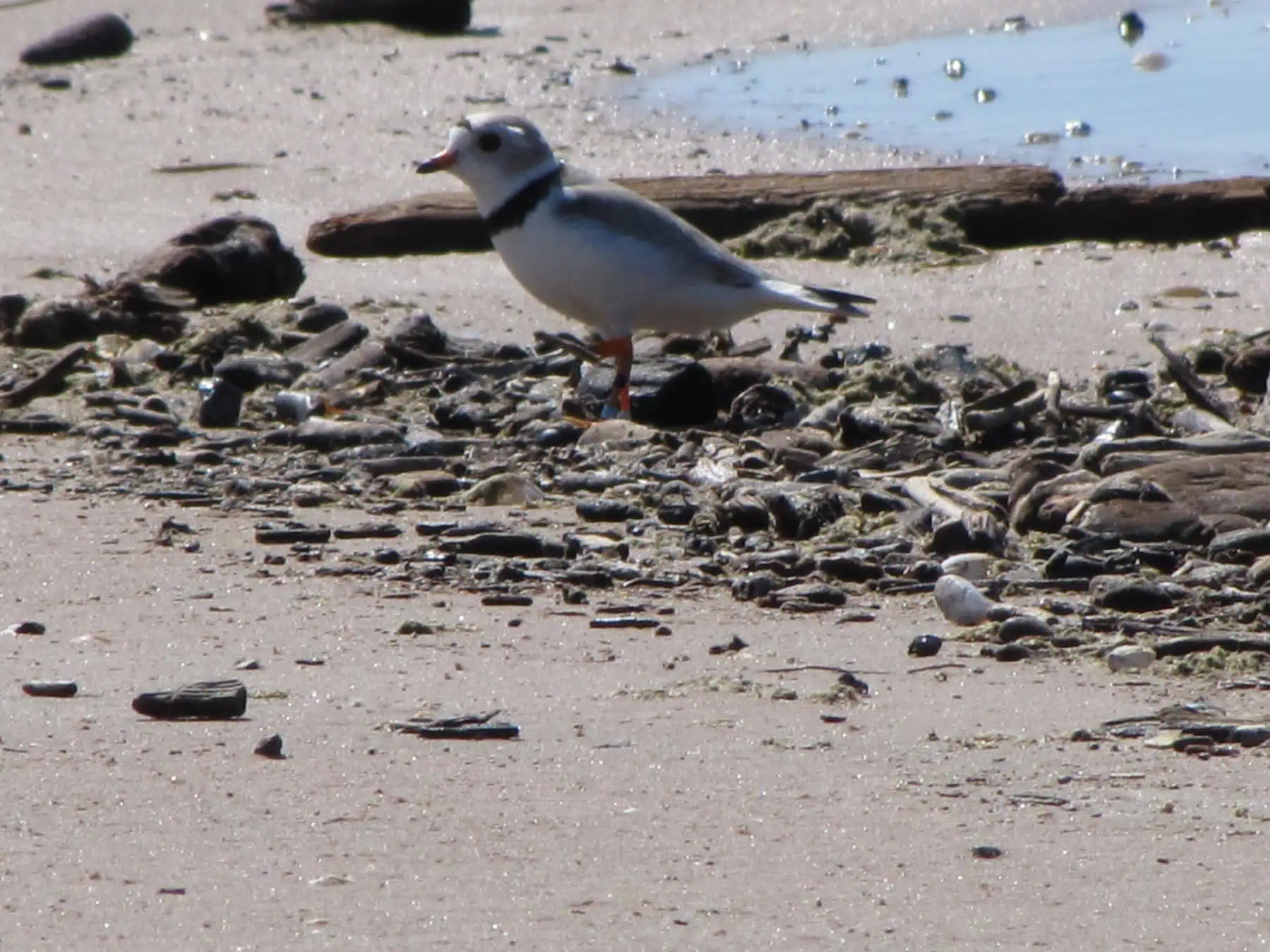
Great Lakes piping plovers nested in 99 pairs this summer, the most since the bird was listed as endangered in 1986 and the fourth record year in a row. It is also 66 percent of the number the federal recovery plan requires, and the plan requires that number for five consecutive years before the plover can even be moved from endangered to threatened.
Which number is the number
Three pair counts are circulating and all are honest if you date them. The Great Lakes Piping Plover Recovery Effort reported 90 pairs on nests in mid June, which is where the “record 90” headlines came from. By early August the count was 99 with 155 wild chicks hatched. On August 25 the Wisconsin DNR put it at 99 breeding pairs and at least 160 wild chicks fledged. Audited totals usually arrive in December.
For scale, 2025 finished at 88 pairs and 2024 at 81. And 2025 had 101 nests, because pairs that lose a first clutch often try again. Nests and pairs are different counts. Pairs is the one the recovery plan uses.
What the recovery plan asks for

The U.S. Fish and Wildlife Service published the Great Lakes recovery plan in September 2003. Reclassification to threatened requires “at least 150 pairs (300 individuals), for at least 5 consecutive years, with at least 100 breeding pairs (200 individuals) in Michigan and 50 breeding pairs (100 individuals) distributed among sites in other Great Lakes states.” It also requires a five-year average of 1.5 to 2.0 fledglings per pair, protected breeding and wintering habitat, and adequate genetic diversity.
The Service’s most recent published five-year review came out in March 2020. It found the fledgling criterion met, at 1.67 chicks per pair averaged over 2009 through 2018, inside the plan’s window of 1.5 to 2.0. It found the pair count nowhere close. The peak year in that review, 2017, counted 76 breeding pairs across the Great Lakes: 52 in Michigan against a target of 100, eight in Wisconsin against a target of 50 for the non-Michigan states, and 14 in Ontario, which the plan does not count toward that target. The bird stayed endangered.
How far back the bottom was
The plan estimates the Great Lakes once held 492 to 682 breeding pairs. At listing on January 10, 1986 there were 17. The low came around 1990, at roughly a dozen pairs, every one in Michigan. The “12 pairs at listing” line in a lot of coverage splices two different years.
The U.P. share
Sleeping Bear Dunes, in the Lower Peninsula, hosts more than a third of the population. The Upper Peninsula’s sites are smaller and harder. In 2025 Whitefish Point had one pair that fledged three chicks, and Vermilion Point had one pair whose two chicks did not survive. Whitefish Point lost about two acres of nesting beach to a winter storm before that season. The U.P. peak was 2013, with a record 12 pairs between Grand Marais and Whitefish Point.

No 2026 U.P. site counts have been published. What is known is that at least one Upper Peninsula nest lost its female this summer. Its chicks were raised at the University of Michigan Biological Station and released at Waukegan, Illinois on August 4.
What is killing them
Merlins. The recovery effort’s field lead, Stephanie Schubel, said the program lost at least eight to ten adults to the small falcons in 2025. A study published this summer in the Journal of Wildlife Management found that relocating merlins 100 to 400 kilometers kept 42 percent of them off their territory for the season. Dogs are the other one. NPS biologist Vince Cavalieri has said plovers flush at 300 feet from a dog, long enough to cook or chill a clutch.
The safety net is a captive rearing facility the Detroit Zoo has run at the Biological Station near Pellston since 1992. Eggs from abandoned nests go there. More than 90 percent of those chicks fledge, against about half in the wild.
If you see one
Leash the dog and give the roped area a wide berth. Adults carry color bands; a photo of the band combination sent to the Great Lakes Piping Plover Conservation Team at greatlakespipingplover.org lets the program track that bird for life.
More worth reading


Yooper Hub community
The conversation
Know something this story missed? Corrections and additions get read by an editor and folded into the article, with credit.
Real neighbors, real names. A Yooper Hub editor reads your first comment before it appears; after that you’re a known neighbor and your comments post right away. No account required. Community guidelines
Nothing here yet. A sentence is plenty: a correction, a name, or what you remember about this place.
Sources, credits, and reporting details
Sources & accountability
How this story was reported
Editorial methodAnalysis
Last verifiedSep. 13, 2026
Corrections statusNo material correction note is recorded on this article.
AI assistanceResearched and drafted with AI tools. Reviewed and approved by editor Keegan O’Brien.
Verification note: RESOLVED Sep 13, 2026. The flagged citation was not findable because it does not exist. The article cited "the Service’s latest five-year review, dated December 2024" and drew four figures from it: a 1.61 fledgling rate for 2019 through 2023, Michigan at 57 pairs in 2023, and 23 pairs in the other states. A third independent search pass this session, across ECOS, the Federal Register and general web, found no December 2024 review for this species. The most recent review that exists is March 2020, and it reads differently on every figure: 1.67 chicks per pair, 2009 through 2018, and a 2017 peak of 76 breeding pairs, 52 in Michigan, 8 in Wisconsin, 14 in Ontario. The paragraph has been rewritten onto that review and every unsourced number removed. The rest of the article was rechecked and holds. The 2003 recovery plan carries the 150-pairs-for-five-years threshold word for word, and 99 pairs as the most since the 1986 listing is independently confirmed. Headline and lead untouched.
Primary sources
-
Recovery Plan for the Great Lakes Piping Plover (Charadrius melodus) — U.S. Fish and Wildlife Service
Published Sep. 16, 2003. Accessed Sep. 13, 2026.
Threshold language confirmed word for word against the plan and the matching Federal Register notice. This is the load-bearing source for the headline.
-
Piping Plover (Charadrius melodus) 5-Year Review: Summary and Evaluation — U.S. Fish and Wildlife Service
Published Mar. 1, 2020. Accessed Sep. 13, 2026.
Confirmed March 2020, ECOS species_nonpublish/3383.pdf, read directly on Sep 13, 2026. This replaced a citation to a "December 2024" review that does not exist: three independent search passes across ECOS, the Federal Register and general web found no such document. The article previously carried 1.61 for 2019 through 2023 and Michigan at 57 pairs in 2023; none of those figures appear in any locatable Service review and all have been removed.
Additional reporting
-
Tiny piping plovers are having another record year on Great Lakes — Great Lakes Commission
Published Aug. 3, 2026. Accessed Sep. 13, 2026.
Independently confirms the record claim and the since-1986 qualifier the headline depends on.
-
Relocating merlins may reduce threats to endangered Great Lakes piping plovers, study finds — Great Lakes Echo
Published Aug. 26, 2026. Accessed Sep. 13, 2026.
The journal article returns a 403, so these figures are carried on this secondary account. Distance and percentage match the article within rounding.
Photo and media credits
-
Piping Plover Adult (Charadrius melodus) (7686098084).jpg (featured image) — Seney Natural History Association, via Wikimedia Commons
Featured image record. Accessed Sep. 13, 2026. CC BY-SA 2.0.
File page confirmed via the Commons API: author Seney Natural History Association, licence CC BY-SA 2.0, 4000 by 3000. Subject and credit match the caption.
_(7686098084).jpg)