Pequaming is a point of land on the east side of Keweenaw Bay, a few miles north of L’Anse, and for most of a century it was a lumber town that belonged to somebody. First it belonged to the Hebards. Then, from 1923, it belonged to Henry Ford. The Ford Motor Company owned the mill, the houses, the school, and the white bungalow on the shore where Ford himself spent his summers. When the mill closed in 1942 the town had about 400 people in it. By 1950 it had about three families.
That is the whole arc, and it is worth walking through, because Pequaming is the other kind of Ford town. At Alberta, south of L’Anse, Ford built a model village from nothing. At Pequaming he did the opposite: he bought one that was already finished, forty years old and running, and made it his.
## Forty years of Hebards
Northern Michigan University’s Beaumier U.P. Heritage Center dates the settlement to 1878, when Charles and Edward Hebard, with H.C. Thurber, put a sawmill on the point to cut pine lumber and shingles. The center describes the Hebard Thurber mill as the first and biggest lumber operation on Lake Superior, which is its characterisation rather than a figure this piece can check, but the scale is not in doubt: the operation eventually held tens of thousands of acres of timber. By 1904, the center says, the company had cut through the area’s virgin pine. Charles Hebard died that year.
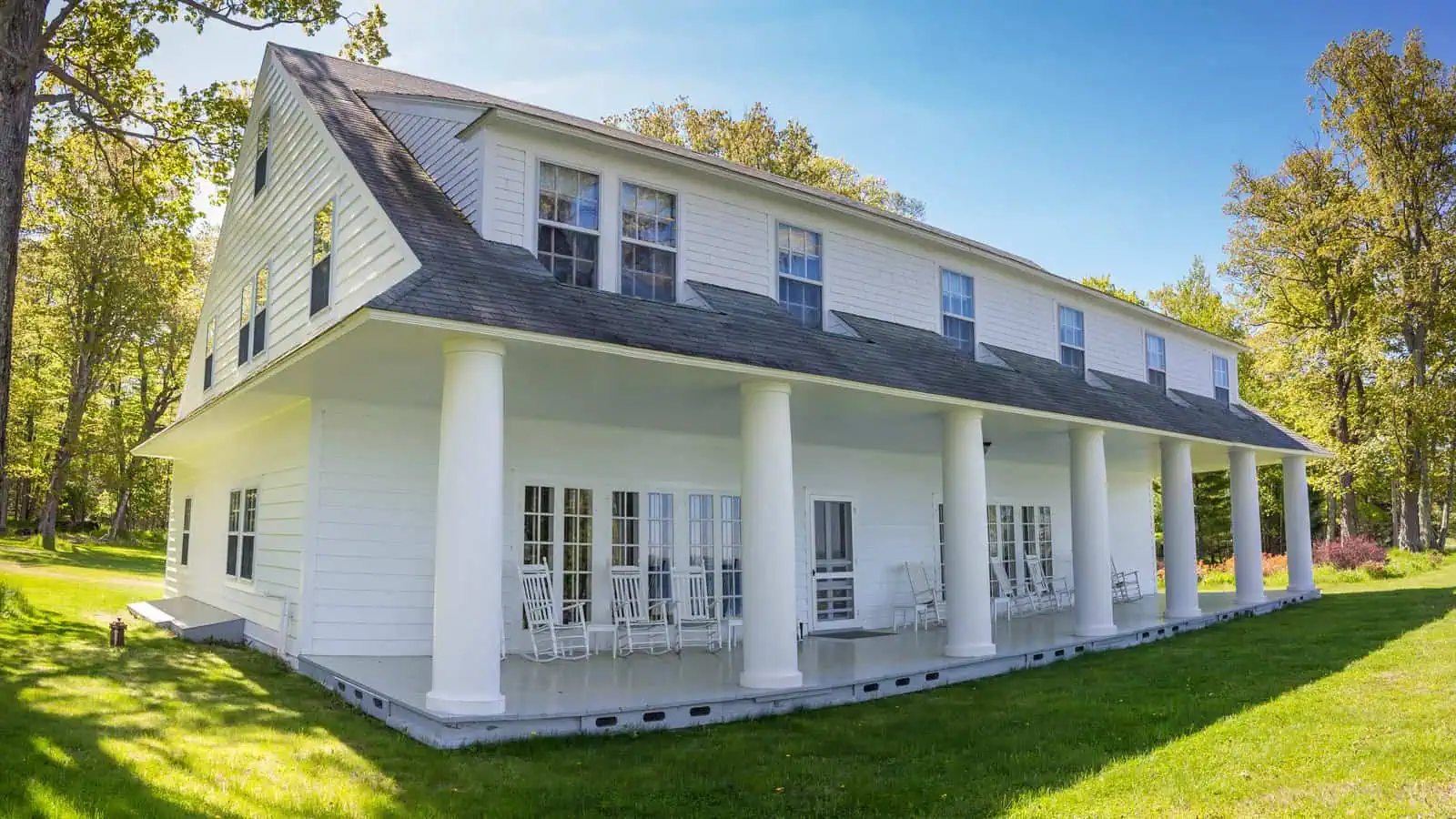
His son Daniel Hebard built the house that would outlast all of it. In 1914 he put up a two-storey frame lodge on the shore as a seasonal residence: white clapboards, a low gable roof, long shed dormers, and a veranda carried on seven cement pillars. Inside were eight bedrooms, seven bathrooms, a large living room, a dining room and an office. The grounds ran to four and a half acres, with outbuildings, formal gardens and a tennis court. It was, and is, called the Bungalow, which undersells it.
## 1923: Ford buys the lot
In 1923 the sons of Charles and Edward Hebard sold 40,000 acres, including the holdings of Charles Hebard and Sons and the town of Pequaming itself, to Henry Ford. Ford wanted the timber for the same reason he wanted Iron Mountain, Alberta and L’Anse: cars in the 1920s were full of wood, and the crates they shipped in were wood too. The Beaumier center’s account is that Ford ran the mills at Pequaming and L’Anse to supply wooden car parts and crating material for the company.
Two changes arrived with the new owner, and the center records them side by side. Wages went from $3.50 a day to $5, Ford’s famous rate. Rents went from $1 a year to $12 a month. Read together, they say a good deal about how a company town works: the money the town paid its people and the money it took back were both set in the same office.
Ford also built. In 1935 the company put up four one-room schools for the elementary and intermediate grades, and in 1937 a high school. And every summer from 1923 to 1941, Henry Ford came north and stayed in Daniel Hebard’s bungalow. He had bought the timber, the mill and the town, and he had bought the best house in it.
## 1942: the mill stops
The mill closed in 1942, and so did the schools. The Beaumier center puts the population at about 400 at that point. Lake Superior Magazine dates the abandonment of the village to 1945, as people moved away in search of work, and records that the Ford Motor Company sold its Pequaming assets in 1952. By 1950, the Beaumier center says, only about three families were left.
That is a fast collapse, even by lumber-town standards, and it is the part of the story that separates Pequaming from Alberta. Alberta ran on until 1954 and was then handed to Michigan Tech, which still owns it. Pequaming was a company asset, and when the company was done with it, it was done.
## What is left
The point is now what the Beaumier center calls a ghost town, though the description is generous in both directions. There are family homes and rentals on the old townsite, and there is commercial fishing off the point. There is also the water tower, and there is the Bungalow.
The Bungalow was designated a Michigan State Historic Site on September 10, 1979, and listed on the National Register of Historic Places on May 5, 1982. Lake Superior Magazine records that a couple named Hartman bought it in the late 1980s, restored it, and ran it as a bed-and-breakfast; the Beaumier center dates the purchase and restoration to 1989. In 1993 Eugene and Kathleen Thompson acquired it, and it now operates year-round as a rental for groups. The magazine’s current description gives it nine bedrooms and six bathrooms and room for sixteen people, which is a slightly different count from the register’s 1982 description of eight and seven; houses get reconfigured, and this piece uses the register’s numbers for the historic house and the magazine’s for the rental.
So the town Henry Ford bought is mostly gone, and the one thing in it he did not build, the lumberman’s summer house, is the thing you can still sleep in.
## Image needs
**BUILT/READY:** `File:Hebard-Ford Summer Home.jpg`, rossograph, CC BY-SA 4.0, 5439×4152, June 2019. The Bungalow itself from the lawn: white clapboard, the shed dormer, the veranda on its pillars, exactly the building the register describes. Same photographer also has `File:Pequaming.jpg` (3013×2535, CC BY-SA 4.0), the water tower over the roofs, which would make a good second image if the piece ever gets one.
## Sources consulted
**Northern Michigan University, Beaumier U.P. Heritage Center, “Pequaming” (Ghost Towns).** https://beaumier.nmu.edu/ghosttowns/towns/Pequaming Source for: settlement in 1878 by Charles and Edward Hebard with H.C. Thurber and the pine and shingle mill; the “first and biggest lumber operation on Lake Superior” characterisation, attributed to the center in the copy; virgin timber exhausted by 1904; the 1923 sale of 40,000 acres including the town to Ford; Ford running the Pequaming and L’Anse mills for car parts and crating; wages $3.50 to $5 and rents $1 a year to $12 a month; four one-room schools in 1935 and a high school in 1937; mill and schools closed 1942; about 400 residents at closure; about three families by 1950; the Bungalow purchased and restored in 1989; the current ghost-town description with homes, rentals and commercial fishing.
**Wikipedia, “Hebard-Ford Summer House,” citing the National Register Information System and the Michigan State Housing Development Authority.** https://en.wikipedia.org/wiki/Hebard%E2%80%93Ford_Summer_House Source for: Daniel Hebard building the lodge in 1914 after his father’s death in 1904; the architectural description (two-storey frame, white clapboard, low gable, long shed dormers, veranda on seven cement pillars, eight bedrooms, seven bathrooms, living room, dining room, office, 4.5 acres, outbuildings, formal gardens, tennis court); Ford’s use 1923 to 1941; State Historic Site September 10, 1979; NRHP May 5, 1982, reference 82002824. Wikipedia’s own reference list also names a Michigan History article, “Henry Ford’s Tasty Little Town: Life and Logging in Pequaming,” which was not obtained; it would be the source to get for any deeper piece.
**Lake Superior Magazine, “The Ford Bungalow: Keweenaw Bay’s Secret Oasis.”** https://www.lakesuperior.com/travel/michigan/386-ford-bungalow-keweenaw-bays-secret-oasis/ Source for: the village abandoned in 1945 as people left for work; Ford selling its Pequaming assets in 1952; the Hartmans buying and restoring in the late 1980s and running a bed-and-breakfast; the Thompsons acquiring in 1993; current year-round group rental; nine bedrooms, six bathrooms, sixteen guests. Also says Daniel Hebard built it “for his bride Julia” and puts Charles Hebard’s purchase of the site at 1879 rather than 1878; the copy uses the Beaumier date and does not use the bride detail.
**The Mining Gazette, “Ford’s contribution to UP remembered,” September 2025.** https://www.mininggazette.com/news/front-page/2025/09/fords-contribution-to-up-remembered/ Corroborates the 1923 sale of 40,000 acres and Ford running the Pequaming and L’Anse mills for wooden car parts and crating; source for Alberta operating until 1954 and then being donated to Michigan Tech, and for Iron Mountain supplying body parts and wood patterns.
### Two things this draft deliberately does NOT say
**A purchase price and an exact date.** The 8/15 NRHP sweep note carried “Ford bought the whole town 1923-09-08 for $2,850,000.” Neither figure appears in any source read for this draft. NMU, Wikipedia, Lake Superior Magazine and the Mining Gazette all say 1923 and 40,000 acres and stop there. The price is very likely in the Michigan History article Wikipedia cites; until someone reads it, the copy says “1923” and nothing more. Do not reinstate the figures from the sweep note.
**”FORD” on the water tower.** The Commons photograph of the tower does not show lettering legibly and no source read here says what, if anything, is painted on it. The copy mentions the tower and stops.
### One conflict, resolved
NMU’s page says the Bungalow “was listed on the National Register of Historic Places” in 1993. The register number is 82002824, a 1982 number, and the MSHDA record gives May 5, 1982. 1993 is the year the current owners acquired the house, per Lake Superior Magazine. The copy uses 1982 for the listing and 1993 for the Thompsons.
More worth reading


Yooper Hub community
The conversation
Know something this story missed? Corrections and additions get read by an editor and folded into the article, with credit.
Real neighbors, real names. A Yooper Hub editor reads your first comment before it appears; after that you’re a known neighbor and your comments post right away. No account required. Community guidelines
Nothing here yet. A sentence is plenty: a correction, a name, or what you remember about this place.
Sources, credits, and reporting details
Sources & accountability
How this story was reported
Editorial methodArchival synthesis
Last verifiedAug. 16, 2026
Corrections statusNo material correction note is recorded on this article.
AI assistanceResearched and drafted with AI tools. Reviewed and approved by editor Keegan O’Brien. Tool: Claude.
Verification note: Ledger written 2026-08-16 before scheduling. The copy deliberately omits a purchase price and exact 1923 date: the 8/15 sweep note carried '1923-09-08 for $2,850,000' but no source read for this draft has either figure; they are likely in the Michigan History article 'Henry Ford's Tasty Little Town' that Wikipedia cites, which was not obtained. NRHP listing is 1982 (ref 82002824), not the 1993 NMU's page gives; 1993 is the current owners' acquisition.
Primary sources
-
Pequaming (Ghost Towns) — Northern Michigan University, Beaumier U.P. Heritage Center
Accessed Aug. 16, 2026.
-
Hebard-Ford Summer House (NRHP and MSHDA records, via Wikipedia) — Wikipedia, citing the National Register Information System and the Michigan State Housing Development Authority
Accessed Aug. 16, 2026.
Additional reporting
-
The Ford Bungalow: Keweenaw Bay's Secret Oasis — Lake Superior Magazine
Accessed Aug. 16, 2026.
-
Ford's contribution to UP remembered — The Mining Gazette
Published Sep. 1, 2025. Accessed Aug. 16, 2026.
Photo and media credits
-
Hebard-Ford Summer Home (featured image) — rossograph, via Wikimedia Commons
Featured image record. Published Jun. 8, 2019. Accessed Aug. 16, 2026. CC BY-SA 4.0.
Commons file Hebard-Ford_Summer_Home.jpg, uploader's own work. Attachment 2471, 1600×900, cropped 16:9 from 5439×4152 and downscaled; crop box in the credit sidecar. Attribution and licence in the caption.