The Bartola Musical Instrument Company of Oak Park built something on the order of 250 theatre pipe organs. They went into movie houses across the Midwest to do a job that no longer exists: play the film.
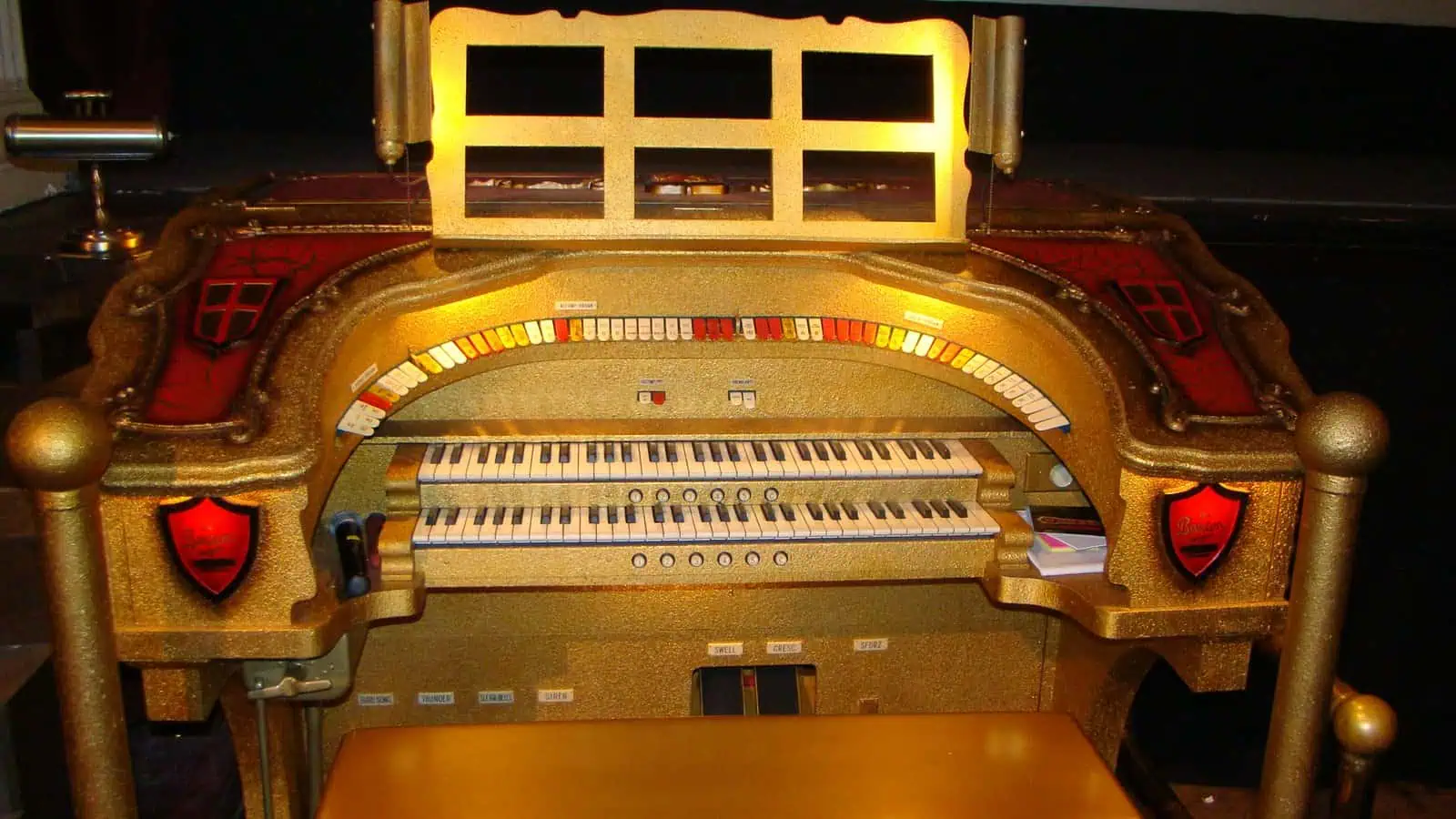
Silent pictures needed sound from somewhere, and the somewhere was an organist in the pit improvising to whatever was on the screen, hitting the chase and the kiss and the villain in real time.
Of those roughly 250 Bartons, an estimated 40 are still in the buildings they were installed in. Of those, only about six are documented as still playable.
Ironwood has one.
The building it lives in
The Ironwood Theatre opened on June 30, 1928, as a vaudeville and movie house, one of three picture houses running in Ironwood at the time. That is worth sitting with on its own. A town on the far western edge of the Upper Peninsula supported three of them.
It was designed by Albert Nelson, an Ironwood architect who was self-taught, and it cost $160,000 to build. The Barton went in as part of the original fit-out, a two-manual, seven-rank instrument, and was opened by an organist named Bayne Cummins.
Then the century happened to it. Sound film arrived within a year of the opening and made the organ’s original job obsolete almost immediately. The theatre kept going for decades anyway, and closed in 1982.
What saved it
The building was donated to the City of Ironwood, and it went onto the National Register of Historic Places in 1985.
What followed was the slow kind of rescue: volunteer hours through the 1990s and into the 2000s, grants, donations, and work done in pieces as money allowed. The organ console went out to a specialist, the Carlton Smith Pipe Organ Restoration company, and came back in June 2010, which finished the console restoration.
That is thirty-two years, counting from the day the doors closed. Nobody restores a theatre organ because it is a good investment.
Why the number matters
Six is a very small number.
An instrument like this is difficult to move and easy to lose. Theatres get demolished, or gutted, or converted, and the organ goes for parts or goes silent because nobody will pay to keep several thousand moving pieces in tune for an instrument with no repertoire booked. Most of the 250 went that way.
The ones that survive tend to survive for the same reason this one did, which is that a specific group of people in a specific town decided not to let it go.
More worth reading


Sources, credits, and reporting details
Sources & accountability
How this story was reported
Editorial methodArchival synthesis
Last verifiedAug. 15, 2026
Corrections statusNo material correction note is recorded on this article.
AI assistanceResearched and drafted with AI tools. Reviewed and approved by editor Keegan O’Brien. Tool: Claude.
Verification note: THE NUMBERS ARE ESTIMATES AND THE COPY KEEPS THE HEDGES: "about 250" Bartons built, "an estimated 40" still in their original homes, "about six" documented as still playable. These are the source's own qualifiers and instrument-survival counts depend on who is counting and what "playable" means. DO NOT tighten them into flat figures, and do NOT let a headline or social post say "the only playable Barton" or "one of six in the world" – the sourced claim is specifically about Bartons still in their ORIGINAL HOMES, which is narrower and more interesting than a global count. NOT CHECKED: the Bartola company being based in Oak Park comes from general reference, not a source read for this piece; verify or cut the clause, nothing depends on it. IMAGE: the organ leads because the organ is the story; a larger exterior photograph exists and would illustrate the wrong article.
Primary sources
-
Ironwood Theatre, National Register of Historic Places record — National Register of Historic Places, via Wikipedia
Accessed Aug. 15, 2026.
-
We Live Up Here: The Historic Ironwood Theatre — WXPR
Accessed Aug. 15, 2026.
Additional reporting
-
Historic Ironwood Theatre — Michigan.org / Historic Ironwood Theatre
Accessed Aug. 15, 2026.
Photo and media credits
-
Barton pipe organ console, Historic Ironwood Theatre, by Billertl — Billertl, via Wikimedia Commons
Featured image record. Accessed Aug. 15, 2026. CC BY-SA 3.0.
16:9 crop box (0,180,2048,1332) from the 2048×1536 original to 1600×900, a 1.28x margin. Amateur interior shot with flash falloff, and the only image of the actual subject under a usable licence. Chosen over the larger 2796×2394 exterior because this article is about an instrument, not a facade. The Historic Ironwood Theatre organisation is worth asking for a better console photograph or the organ being played.
