The Bay de Noquet Lumber Company cut and processed its last log on July 26, 1951. It had been doing that at Nahma, on Big Bay de Noc near the mouth of the Sturgeon River, since 1881. Seventy years, something over two and a half billion board feet, and at its height more than a thousand men working the mill and the lumber camps.
The company also owned the town. Not most of it. The town.
So when the timber ran out, it did the thing that follows logically and still sounds impossible. It advertised Nahma for sale. All of it.
Sold, one town
Ads went out across the country. The asking price was $250,000 for a community of roughly 750 people, and reporting on the sale describes one stipulation attached to it: whoever took the town over had to create jobs.
That condition is the part worth stopping on. A company liquidating an asset had no obvious commercial reason to care what happened to the people living on it. Somebody wrote them into the terms anyway.
*Life* magazine ran a feature on it under the headline “Sold-One Town.” For a while in 1951, a Delta County lumber settlement was a national curiosity.
Who bought it
The buyer was the American Playground Device Company of Indiana, which made wooden playground equipment. The plan, as reported, was to turn Nahma into a resort town.
It did not really work. The playground company was able to employ only about a third of the residents.
That is the ordinary ending, and it is worth being plain about. The condition in the contract was decent. It could not manufacture demand for a town whose entire reason for existing had just been cut down and shipped out. A stipulation can oblige a buyer to try. It cannot make the arithmetic work.
What is still there
Nahma did not vanish. It is a township today, on the water, next to the Hiawatha National Forest, and people live there.
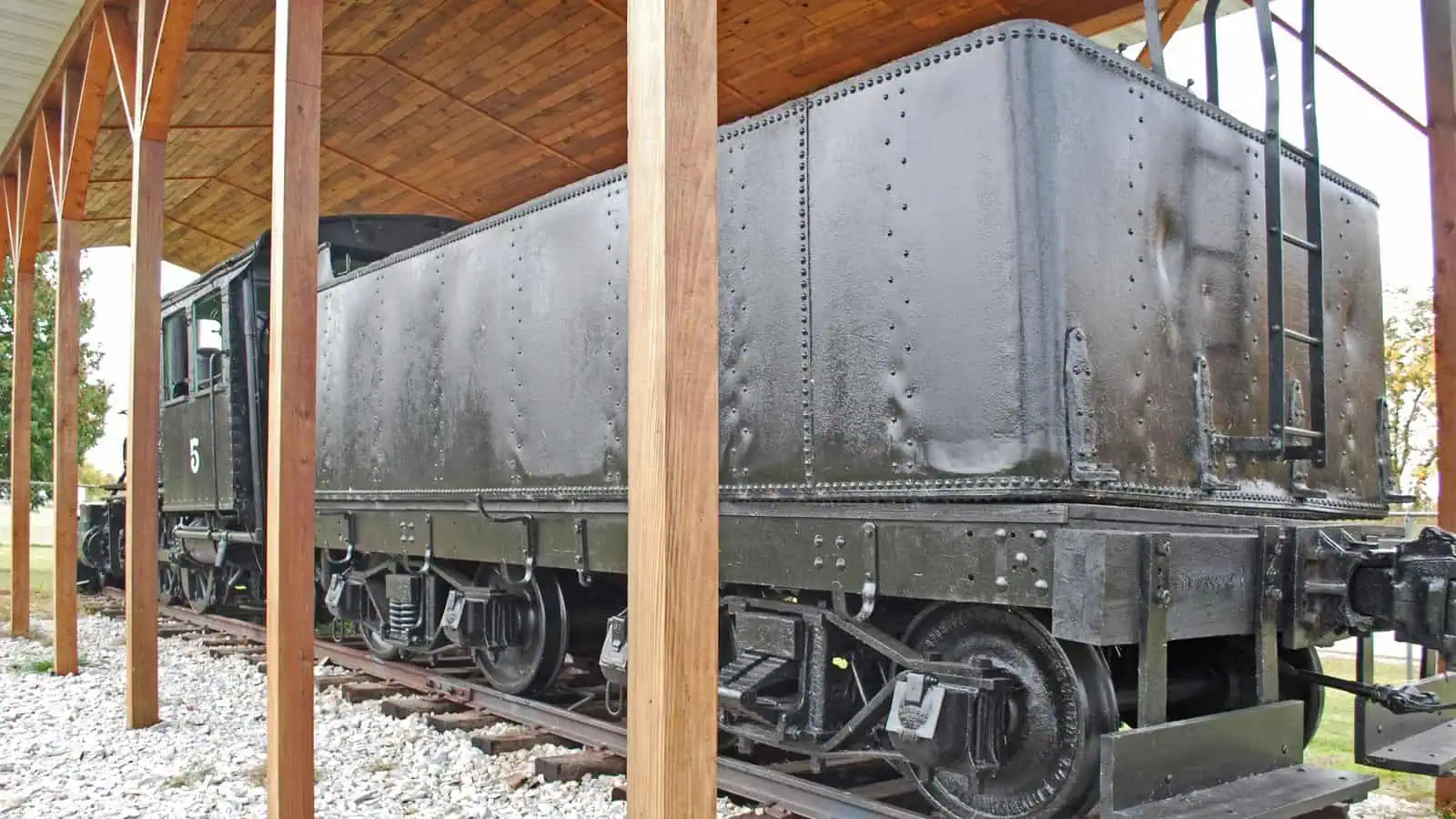
The Nahma Inn still operates, in a building put up in 1909 to house Bay de Noquet employees. And parked in town under a shelter is locomotive number 5 of the Nahma and Northern, the company railroad that once ran seven locomotives over seventy-five miles of track hauling logs to the mill.
A company that owned an entire town left behind a hotel for its workers and one engine. That is not nothing, and it is a strange proportion.
Go See It: Nahma, Michigan — address, hours, cost, season and drive times.
Go See It
Nahma, Michigan
- Hours
- The town itself has no set hours (residential community; the historic locomotive display is outdoors and always viewable). The Nahma Inn restaurant/lounge runs seasonal summer hours: Wed-Thu noon-8pm, Fri-Sat noon-9pm, Sun noon-8pm, closed Mon-Tue.
- Cost
- Free to walk the town and view the historic locomotive and company-town buildings. The Nahma Inn charges its normal rates for dining and lodging — call (906) 644-2486 for current prices.
- Season
- Summer (June through early September) is the practical window — the Inn posts summer hours and the outdoor draws (boat launch, fishing) are warm-weather activities. No source gives an explicit best-season recommendation; this is inferred, not sourced.
- Drive
- From Marquette: 1 hr 14 min, 70.1 miles via US-41 S (Google Maps route, usual traffic, read Sept. 27, 2026)
From the Bridge: 1 hr 58 min, 115 miles via US-2 W, with the Mackinac Bridge toll (Google Maps route, usual traffic, read Sept. 27, 2026) - Call first
- the Nahma Inn & General Store was listed for sale on the open market in 2026 (that listing has since expired); its own site still posts active hours and a phone number, so treat it as operating but confirm by phone — (906) 644-2486 — before you drive out expecting it open.
- What to actually see
- the Nahma and Northern Railway's Engine No. 5 steam locomotive on static outdoor display at Main St. and River St. (free, always viewable — last confirmed in place as of 2010, worth double-checking); the 1909 Nahma Inn building itself; and the public boat launch and fishing piers on Big Bay de Noc.
- Background
- the whole town was built and owned by the Bay De Noquet Lumber Company from 1881 until the mill closed in 1951, when the town — homes, church, school and all — was sold at once to an Indiana buyer, a sale Life magazine covered as "Sold — One Town."
More worth reading


Sources, credits, and reporting details
Sources & accountability
How this story was reported
Editorial methodArchival synthesis
Last verifiedAug. 15, 2026
Corrections statusNo material correction note is recorded on this article.
AI assistanceResearched and drafted with AI tools. Reviewed and approved by editor Keegan O’Brien. Tool: Claude.
Verification note: ATTRIBUTION CARE: the $250,000 asking price and the stipulation that the buyer had to create jobs carry this article and come from secondary reporting on the Delta County Historical Society "Selling Nahma" exhibit, not from a document. The copy attributes the stipulation in line ("reporting on the sale describes") rather than asserting it flatly. Do NOT upgrade these to bald assertions unless an actual advertisement surfaces. FIGURES THAT DISAGREE: peak employment is given as over 1,500 men by the Nahma Inn history and over 1,200 by visitor material, so the copy says "more than a thousand", which both support. Population is over 800 at peak versus roughly 750 at the time of sale; not necessarily contradictory since a mill town shrinks as the mill winds down, and 750 is used only for the moment of sale. IMAGE GAP: there is NO usable image of Nahma itself on Commons, zero landscape files at 1600px or wider in either relevant category. The locomotive is standing in for the town. The Life magazine feature "Sold-One Town" is a rights question and must not be lifted from a scan.
Primary sources
-
History of a Lumber Town — Nahma Inn
Accessed Aug. 15, 2026.
-
"Selling Nahma" exhibit tells story of a town for sale — ABC 10 / CW 5, on the Delta County Historical Society exhibit
Published Jun. 4, 2014. Accessed Jun. 4, 2014.
Additional reporting
-
Nahma Township and Delta County visitor material — Nahma Township
Accessed Aug. 15, 2026.
Photo and media credits
-
Nahma and Northern Railway locomotive number 5, by Andrew Jameson — Andrew Jameson, via Wikimedia Commons
Featured image record. Accessed Aug. 15, 2026. CC BY-SA 3.0.
16:9 crop box (0,150,3872,2328) from the 3872×2592 original down to 1600×900. KNOWN FLAW accepted knowingly: the display shelter posts cut vertically across the frame. The alternate file Nahma MI Locomotive A.jpg was downloaded and inspected and is a tight boiler view that never reads as a whole locomotive, so it is worse as a lead. Chosen frame shows the complete machine with cab number 5 legible, which the closing paragraph refers to.
