On January 21, 1900, a four-storey sandstone building opened on a hill in Hancock, and an entire college moved inside it.
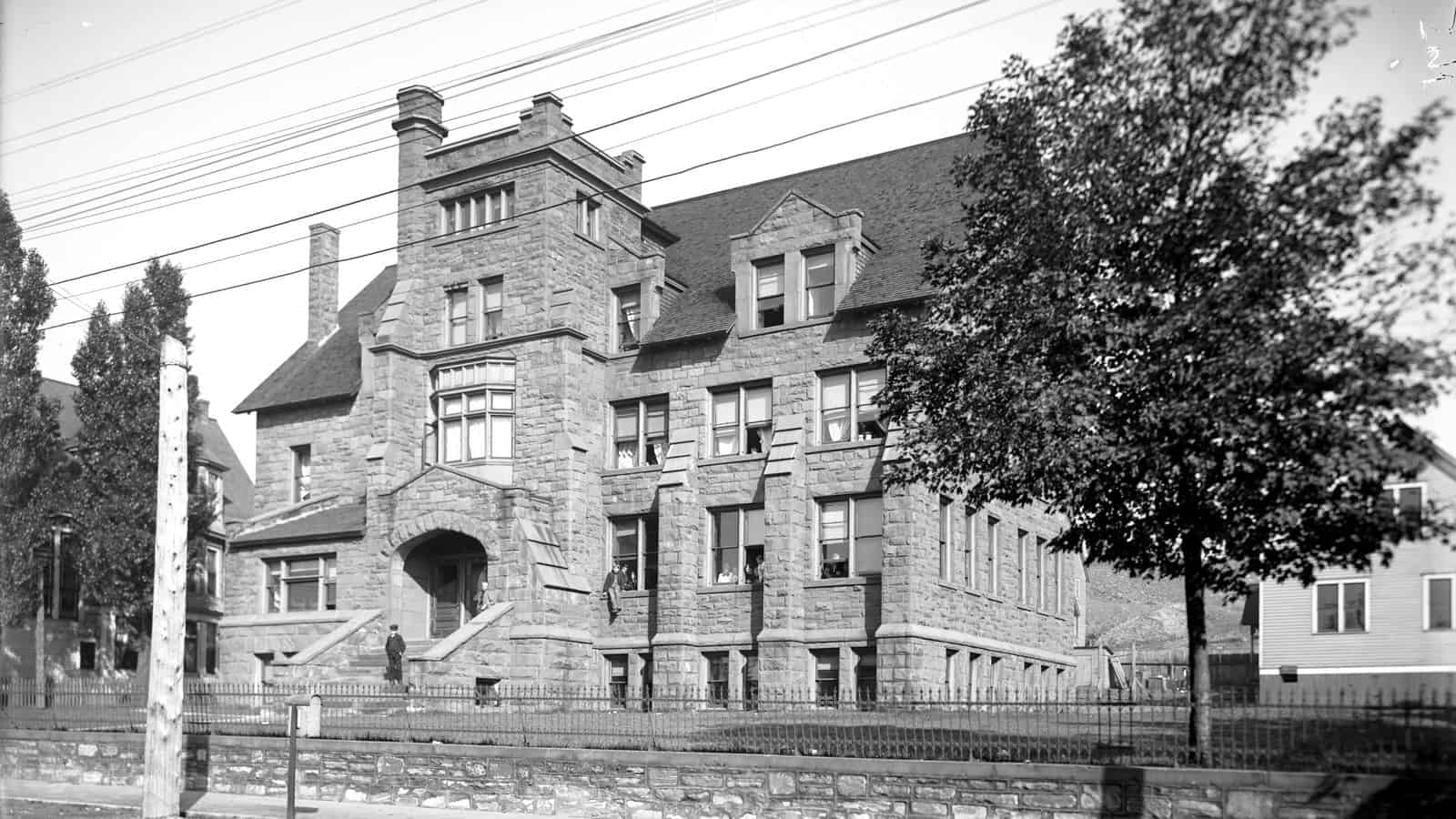
Not a department. The college. Old Main held the dormitory where students slept, the kitchen that fed them and the laundry that washed for them, plus the classrooms, the offices, the library, the chapel and the lounge. One roof over the whole enterprise, because that was what the money would stretch to.
The money was $40,000, and it came from Finnish immigrants in a copper town.
Where it came from
Suomi College was founded on September 8, 1896, by Finns who had arrived in the Copper Country in the 1880s and after, drawn by the mines. They wanted a school of their own, one that would train ministers and teach their children in a way that kept the language and the faith intact rather than dissolving them into the country around.
They laid Old Main’s cornerstone on May 30, 1898. Charles Archibald Pearce designed it in the Richardsonian Romanesque style, which is the heavy, arched, rough-stone manner of the period, and it was built from rough Jacobsville sandstone quarried at Portage Entry, down where Lake Superior narrows into Portage Lake.
That is worth a pause. The stone for the building came out of the ground at the same spot where, eight years later, promoters would put up a dance pavilion and a roller coaster and call it White City. The same small stretch of shoreline supplied a college and a resort inside a decade, and only one of them is still standing.
The one that lasted
Finnish immigrants founded a number of institutions in America. Suomi outlived all of them. By the end it was the longest-surviving educational institution in the United States founded by Finnish immigrants, and along the way it became something broader than a seminary, an academic centre and a cultural anchor for Finnish America.
Old Main itself was recognised early. Michigan made it a State Historic Site on February 12, 1959, and it went onto the National Register of Historic Places on January 13, 1972. In its last stretch, from 2009 to 2023, it had stopped being the whole college and become the administrative side of one: financial aid, admissions, student accounts.
Then the arithmetic caught up.
The school, by then Finlandia University, closed after the spring semester of 2023. The reasons given were the ones closing small colleges everywhere: fewer high school graduates to recruit from, a sharp drop in how many of them wanted to go to college at all, and a debt load the institution could not carry. Northern Michigan University guaranteed admission to its students. That is a decent landing for the people involved and it does not change what closed.
One hundred and twenty-seven years, ended by demographics.
What is there now
Old Main was sold to a private owner and restored. It now operates as the Old Main Inn, a bed and breakfast and a wedding and event venue, with an artist collective and gallery inside it.
There is an easy sour note available here, about a college becoming a hotel, and it is not really the right one. The building was put up to hold a whole community’s ambition in one place, and it has been kept, repaired and filled with people again. Plenty of buildings in the Copper Country got a worse ending than being cared for by somebody who wanted it.
More worth reading


Sources, credits, and reporting details
Sources & accountability
How this story was reported
Editorial methodArchival synthesis
Last verifiedAug. 15, 2026
Corrections statusNo material correction note is recorded on this article.
AI assistanceResearched and drafted with AI tools. Reviewed and approved by editor Keegan O’Brien. Tool: Claude.
Verification note: NOT ASSERTED: no year is given for the rename from Suomi College to Finlandia University. The copy says "by then Finlandia University" without a date because no source actually read for this piece supplied one, and it is the kind of round number easy to half-remember wrong. Add the year only from a source you have opened. Enrolment at closure and the debt figure are likewise not stated, since the reporting read gave neither. TONE: the closing section deliberately declines the obvious college-becomes-a-hotel lament; the building was restored rather than lost. Do not sharpen that into elegy.
Primary sources
-
Old Main, Suomi College, National Register of Historic Places record — National Register of Historic Places, via Wikipedia
Accessed Aug. 15, 2026.
-
Michigan university founded by Finnish immigrants is closing — The Detroit News
Published Mar. 2, 2023. Accessed Aug. 15, 2026.
Additional reporting
-
Deeply saddened: Community reacts to Finlandia closure — The Daily Mining Gazette
Published Mar. 1, 2023. Accessed Aug. 15, 2026.
Photo and media credits
-
Suomi College and Theological Seminary, Old Main, Hancock (Detroit Publishing Company) — Detroit Publishing Company Collection, via Wikimedia Commons
Featured image record. Published Jan. 1, 1903. Accessed Aug. 15, 2026. Public domain.
Public domain Detroit Publishing plate, 9559×7656, dated between 1900 and 1906, showing the building within a few years of opening. 16:9 crop box (0,700,9559,6077) down to 1600×900, keeping the full tower, arched entrance, the figure on the steps and the iron fence. The Detroit Publishing caption in the bottom margin is deliberately cropped out, the opposite call from the Ardis Furnace plate where the lettering is the story. Source scan is 73 megapixels and needs Image.MAX_IMAGE_PIXELS = None to open.
