There is one good photograph of the Ardis Furnace. It was made into a postcard around 1910, and it shows a working plant in Iron Mountain: a timber headframe, a tall concrete building, a stack running black smoke off the top corner. Down at the bottom edge someone has lettered the caption by hand in white, the way real photo postcards were captioned then. It reads ARDIS FURNACE, IRON MT MICH.
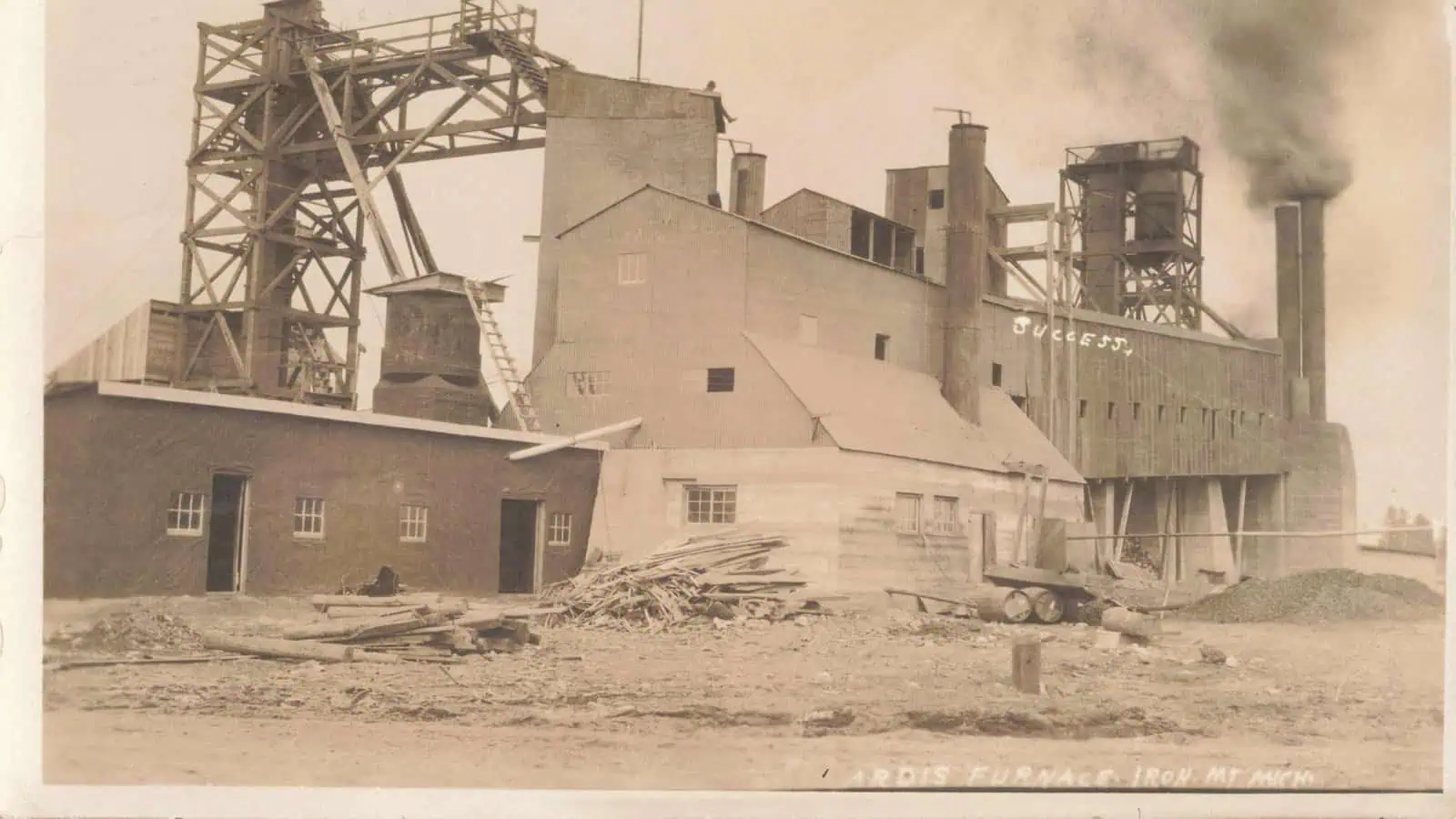
The same hand wrote one more word, up on the side of the building.
SUCCESS!
That word is the reason this story is worth telling, because the Ardis Furnace was not a success. It was a catastrophe that took a man’s fortune and his house inside of two years, and the photograph announcing otherwise is the only picture of it most people will ever see.
The man was John T. Jones, and he was not a crank. He was an Iron Mountain mining man working on the most valuable unsolved problem in the industry: how to get usable iron out of low-grade ore. The good ore was going to run out. The poor ore was everywhere, and nobody could smelt it economically.
Jones filed his patent on March 10, 1908, and it was granted on June 9 of the same year, three months later, as US patent 890,234, “Method of treating iron ores.” It is a genuinely clever document. The whole idea turns on refusing to do the thing every furnace does.
A blast furnace melts everything and separates the iron from the slag as liquids. Jones proposed to never melt the iron at all. In the first stage, ore would travel down through inclined rotating cylinders in an atmosphere of reducing gas, hot enough to strip the oxygen out of the iron oxide but held deliberately below the point where anything went fluid. The patent is explicit about the restraint, describing the reduction as happening “without, however, rendering either the metallic iron or slag producing constituents of the ore fluid.” In the second stage the reduced material went to an open hearth and was brought to roughly 2,000 to 2,200 degrees Fahrenheit, which is hot enough to melt the slag and not the iron. The slag would then simply run off downhill and leave the metal behind, in Jones’s words, “in a pure, or nearly pure, condition.” He claimed it came out dephosphorized as a bonus, which for steelmakers was close to a magic trick.
So he built it. A metal tube 120 feet long and eight feet across, lined with firebrick, set at a slight incline, turned by an electric motor, with the refined iron collecting at the low end. He named it the Ardis Furnace, after his daughter.
The early results were good enough that he built more. Additional furnaces went up at Marquette and at Republic, on the reasoning that if ore could be refined where it came out of the ground, the savings in shipping alone would be enormous. That is a man expanding, not a man hedging.
Then the lining failed.
The firebrick could not survive the heat of the reaction. This is the entire cause of death, and it is worth sitting with how ordinary it is. The chemistry was sound. The engineering logic was sound. What could not hold was the material he had to build the inside of the tube out of. Consulting engineers were brought in and made improvements, and the heat kept destroying the lining anyway.
Jones put his own money in until there was none. He lost everything, the house included. The furnace was taken apart and sold for scrap.
The ruin sat at the corner of Aragon and Antoine for sixty years. In the early 1970s the Menominee Range Historical Foundation moved to save what was left, and the Hanna Mining Company bought the site and donated it. Michigan made it a State Historic Site in 1971, and it went on the National Register of Historic Places on June 29, 1972.
What is actually on the National Register is a set of concrete footings. Not the tube, not the plant, not the process. The part that held.
He was chasing the right problem, too. Getting iron out of poor ore was the question the whole range would eventually live or die on, and it outlasted him by decades. Jones simply got there before anything existed that could take the heat.
More worth reading


Sources, credits, and reporting details
Sources & accountability
How this story was reported
Editorial methodArchival synthesis
Last verifiedAug. 15, 2026
Corrections statusNo material correction note is recorded on this article.
AI assistanceResearched and drafted with AI tools. Reviewed and approved by editor Keegan O’Brien. Tool: Claude.
Verification note: Process description follows US patent 890,234 directly. Wikipedia and mindat label Ardis an "experimental blast furnace"; the patent describes a method that deliberately avoids melting the iron, which is the opposite of blast furnace practice. Do not "correct" the copy back to the popular label.
Primary sources
-
US patent 890,234, Method of treating iron ores, John T. Jones — United States Patent Office
Published Jun. 9, 1908. Accessed Aug. 15, 2026.
-
National Register of Historic Places listing, Ardis Furnace, Dickinson County — Wikipedia, NRHP record
Accessed Aug. 15, 2026.
Additional reporting
-
The Ardis Furnace in Iron Mountain — Northern Michigan History
Accessed Aug. 15, 2026.
Photo and media credits
-
Ardis Furnace, Iron Mt., Mich., 1910 (real photo postcard) — Unknown author, via Wikimedia Commons
Featured image record. Published Jan. 1, 1910. Accessed Aug. 15, 2026. Public domain.
Public domain, unknown author, dated 1910. CROP IS LOAD-BEARING: bottom-aligned 16:9 crop, box (0,213,3216,2022) down to 1600×900, chosen so BOTH hand-lettered inscriptions survive, the word SUCCESS on the building and the ARDIS FURNACE, IRON MT MICH caption along the bottom edge. A centred crop clips the caption. The lettering is the subject of the article opening.
