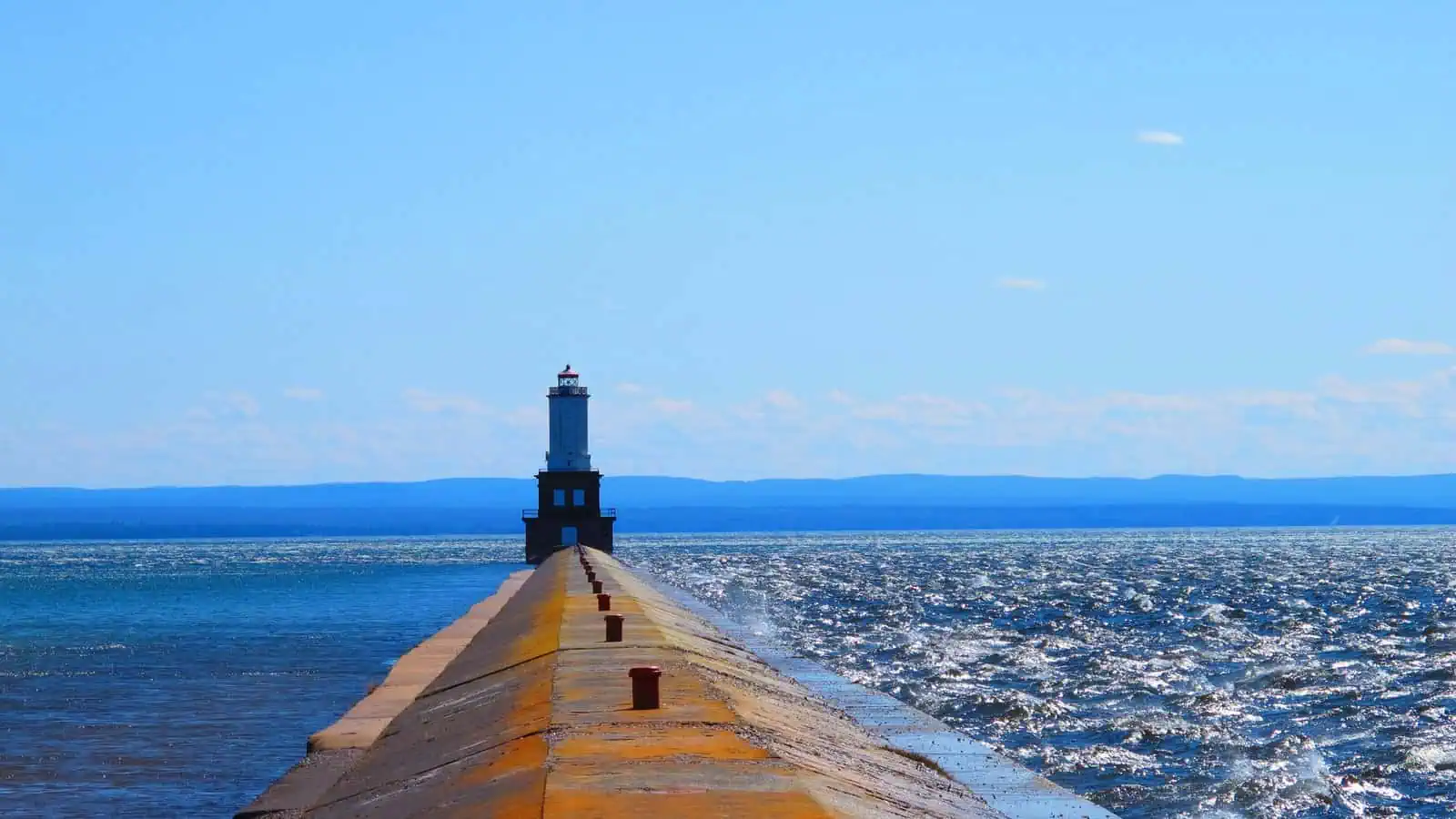
Drive south out of Lake Linden today, follow the township road as it winds toward Jacobsville, and you end up at a public beach with a lighthouse standing off the end of a breakwater. The beach is called White City. Almost nothing there explains the name.
For about eleven summers it was the closest thing the Copper Country had to a seaside resort, and the strangest part of it is how people got there.
The spot sits where Lake Superior narrows and Portage Lake begins. Long before anyone tried to sell tickets, residents called it Portage Entry, or just the Entry. Promoters began looking at it seriously in 1906 and 1907 as a place to put an amusement park, and construction started in 1908 under a man named George Hocking. In 1909 the White City Company was incorporated and W. H. Labb took over the main work of building the place up. The Michigan Tech Archives, which holds the record, describes Labb plainly as a great promoter, and the list of what went up on that shoreline suggests they are being literal.
There was a dance pavilion, later remodeled with a porch. A hotel with its own dining room. A restaurant and saloon. Bathhouses spread along fifteen hundred feet of shoreline. Rental cottages for people who wanted to stay. An electrical plant to run all of it. A merry-go-round with carved horses. A sandstone sidewalk ran from the dock up to the pavilion, which tells you something about how the place expected to be entered.
And for a while there was a roller coaster, the only one the Keweenaw ever had, running a half-mile figure-eight track. It did not last. The archives note it was removed after a fairly short run, and the building that had served as its station was turned into a lounge, which is the kind of detail that says more about the economics than any ledger would.
Here is the part that has no modern equivalent. There was no road worth driving. Getting to White City meant getting on a boat.
Steamboats came down through the Portage loaded with passengers and put them off at the dock for about fifty cents, round trip. They had names: the Plow Boy, the Uarda, the R. B. Hayes, the International, the A. Wehrle. The dock had to be extended more than once to keep up. Moonlight excursions on those boats became popular in their own right, which means that for a lot of people the trip across the water was not the inconvenient part of the evening. It was part of the evening.
Think about what that made the place. You could not drift over on a whim or leave early because you were tired. You bought passage, you went with everyone else who bought passage, and you came back when the boat came back. A night at White City was a commitment measured in hours, and it moved as a group.
What ended it was not a fire or a storm. It was two things arriving at once.
Michigan voters approved a state prohibition amendment in November 1916, years ahead of the national ban. That took out the saloon, and the saloon was the profitable part. Then the war pulled at the rest of it, thinning out the leisure travel that filled the boats and making a summer spent at a resort feel like the wrong thing to be doing. After a sluggish 1919 season the operation stopped. The last steamboat was sold that September.
The buildings went the way unused wooden buildings on a Lake Superior shore go. The archives sum up what is left in five words: little remains but the name.
That is the thing worth sitting with. White City did not fail because people stopped wanting it. It failed because the two things holding it up, cheap liquor and cheap boat passage on an ordinary summer evening, both went away inside of three years. A place can be perfectly well loved and still not survive losing its supports.
The name outlasted all of it. People still drive down there, park, and swim at a beach named for an amusement park that closed before their grandparents were born.
Go See It: White City Township Park, Portage Entry — address, hours, cost, season and drive times.
Go See It
White City Township Park (site of the historic White City resort), Portage Entry
- Hours
- No posted hours found for the park or the lighthouse grounds/pier. Treat as daylight-hours day use; the uptravel.com listing notes the township may set closing hours and alcohol restrictions, without giving specific times.
- Cost
- Free — no admission fee found for the park or the lighthouse grounds/pier.
- Season
- Summer (June through early September) for swimming and beach use. This is an exposed Lake Superior shoreline and the roads out here are not maintained for winter tourist traffic.
- Drive
- From Marquette: 2 hr 26 min, 128 miles via US-41 N (Google Maps route, usual traffic, read Sept. 27, 2026)
From the Bridge: 5 hr 8 min, 291 miles via M-28 W and US-41 N, with the Mackinac Bridge toll (Google Maps route, usual traffic, read Sept. 27, 2026) - What's actually there
- a small (about 3-acre) township beach park with picnic area and fishing access; about a mile south near Jacobsville, a boat launch with a hard-surface ramp, roughly 20 parking spots and toilets; and, at the end of Dreamland/Jacobsville Road, a parking area from which you can walk the pier out to the Keweenaw Waterway Lower Entrance Light (grounds open, tower closed, no fee).
- Realistic visit
- park, walk the beach, picnic, fish, and walk the pier to photograph the lighthouse.
More worth reading


Sources, credits, and reporting details
Sources & accountability
How this story was reported
Editorial methodArchival synthesis
Last verifiedAug. 15, 2026
Corrections statusNo material correction note is recorded on this article.
AI assistanceResearched and drafted with AI tools. Reviewed and approved by editor Keegan O’Brien. Tool: Claude.
Primary sources
-
Flashback Friday: A White City in the Copper Country — Michigan Tech Archives and Copper Country Historical Collections
Published Jan. 21, 2022. Accessed Aug. 15, 2026.
Additional reporting
-
Commons file description, Keweenaw Waterway Lower Entrance Light — Wikimedia Commons
Accessed Aug. 15, 2026.

Photo and media credits
-
Keweenaw Waterway Lower Entrance Light at White City Beach, by Chadrjohnson — Chadrjohnson, via Wikimedia Commons
Featured image record. Published Apr. 8, 2012. Accessed Aug. 15, 2026. CC BY-SA 3.0.
Photographer Chadrjohnson, own work. Centred 16:9 crop of the 3648×2736 original down to 1600×900, no upscaling. Credit line as printed: Photo: Chadrjohnson, CC BY-SA 3.0, via Wikimedia Commons.