The Army built a fort at the top of the Keweenaw in 1844, garrisoned it with two companies of infantry, and waited for the trouble to start.
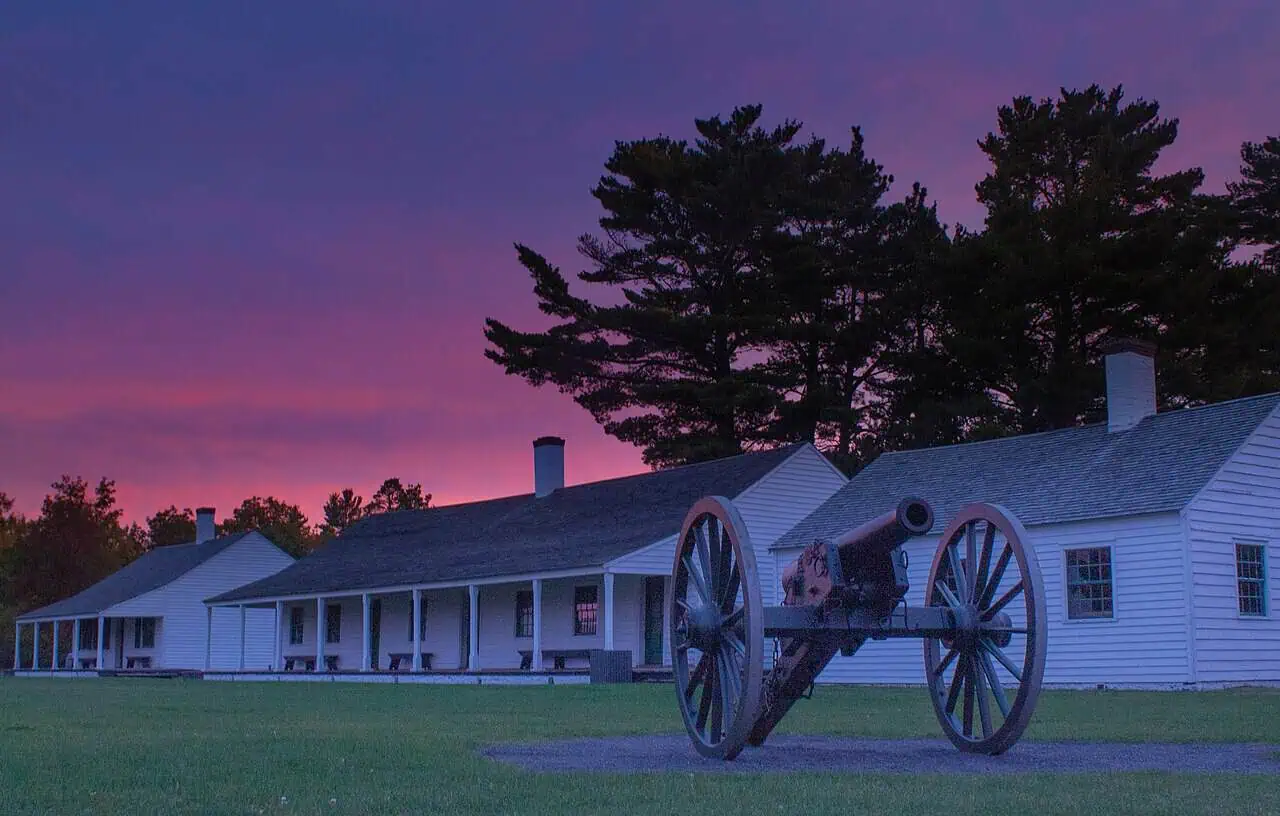
It never did. Nobody ever fired a shot at Fort Wilkins. That is the whole reason it is still standing.

What they were afraid of
Douglass Houghton’s 1841 report on the copper veins around Copper Harbor set off a stampede. The 1842 Treaty of La Pointe transferred the land, and by 1843 men were pouring into a place that had almost no law in it.
Washington did the arithmetic and did not like the answer: a remote frontier, a rough and rapidly growing mining population, and the Ojibwe who had just ceded the ground. The War Department ordered a post built, and named it for Secretary of War William Wilkins.
They did not build a small thing. Twenty-seven structures went up — two barracks, seven officers’ quarters, mess halls, a hospital, a bakery, a blacksmith shop, a powder magazine, a slaughterhouse, four sets of quarters for married enlisted men.
The trouble that never came
The anticipated conflict simply did not happen. The Ojibwe kept the peace. The miners, by the accounts that survive, were mostly law-abiding. What actually thinned the crowd was not violence but the Keweenaw itself — the isolation and the winters ran off more prospectors than any garrison could have.
So the soldiers sat. By 1845 half the garrison was pulled for the Mexican-American War, and the rest were gone in 1846. A caretaker held the buildings until the mid-1850s.
Troops came back once, from 1867 to 1870, mostly Civil War men serving out enlistments in a place where nothing was expected to happen. Then the Army decided the post cost more than it was worth and left for good.
Total time garrisoned across 26 years: about five.

Why boredom preserved it
Here is the part that makes Fort Wilkins unusual. Forts that see fighting get burned, shelled, rebuilt, or stripped. This one got picnics.
After the soldiers left, people came out to camp and eat lunch among the buildings. Photographs from around 1910 show the structures sagging but intact. Houghton and Keweenaw counties bought the site in 1921, and in 1923 it became a state park — which means it has now been a park for roughly a century, twenty times longer than it was ever an active post.
Nineteen buildings stand today and twelve of them are original 1840s construction. Others were rebuilt on their footprints after archaeological work. It is considered the most complete surviving example of an 1840s army post anywhere in the United States, and it went on the National Register in 1970.
What you actually walk into
The park covers 987 acres on the strip of land between Lake Fanny Hooe and Copper Harbor. Most of the buildings are open, with exhibits inside on military and civilian life during the fort’s brief working years, and costumed interpreters through the summer season.
The Copper Harbor Lighthouse, built in 1866, is part of the same park. There is a modern campground on the grounds.
Making the trip north
Fort Wilkins is about a mile east of Copper Harbor in Grant Township, at the end of US-41 — genuinely the end; the highway stops there. A Michigan Recreation Passport gets you in. Living history programming runs in summer, and the buildings close up for the season in fall.
It is a cooperating site of Keweenaw National Historical Park, so it pairs naturally with the Delaware Mine twelve miles south and the Jampot on the shore road down to Eagle River.
Go See It
Fort Wilkins Historic State Park
- Hours
- 8:30 a.m. to dusk, daily.
- Cost
- Fort admission is free. A Michigan Recreation Passport is required for vehicle entry.
- Season
- Open mid-May to mid-October. The state historic sites page says the fort opens for the season on May 15.
- Drive
- From Marquette: 2 hr 50 min (147 mi) via US-41 N
From the Bridge: 5 hr 29 min (310 mi) via US-41 N (toll on the Bridge) - Park phone
- 906-289-4215. The season ends mid-October, so late-September and early-October trips should call ahead.
More worth reading


Yooper Hub community
The conversation
Know something this story missed? Corrections and additions get read by an editor and folded into the article, with credit.
Real neighbors, real names. A Yooper Hub editor reads your first comment before it appears; after that you’re a known neighbor and your comments post right away. No account required. Community guidelines
Nothing here yet. A sentence is plenty: a correction, a name, or what you remember about this place.
Sources, credits, and reporting details
Sources & accountability
How this story was reported
Editorial methodArchival synthesis
Last verifiedAug. 15, 2026
Corrections statusNo material correction note is recorded on this article.
AI assistanceResearched and drafted with AI tools. Reviewed and approved by editor Keegan O’Brien. Tool: Claude Opus 5.
Verification note: Ledger reconstructed 2026-08-15 from the DNR's park page and Pure Michigan's listing (Michigan History Center program), with Wikipedia as pointer for the 1844-1846 and 1867-1870 garrison dates.
Primary sources
-
Fort Wilkins Historic State Park — Michigan Department of Natural Resources
Accessed Aug. 15, 2026.
-
Fort Wilkins Historic State Park — Pure Michigan / Michigan History Center
Accessed Aug. 15, 2026.
Supports: Built 1844 to keep order in the Copper Rush; abandoned in 1870; a state park since 1923.
Additional reporting
-
Fort Wilkins Historic State Park — Wikipedia contributors
Accessed Aug. 15, 2026.
Supports: The 1846 withdrawal for the Mexican War, reoccupation 1867-1870, and the National Register record.
Pointer.
Photo and media credits
-
Fort Wilkins at sunrise (featured image) — CorynHamill, via Wikimedia Commons
Featured image record. Accessed Aug. 5, 2026. CC BY-SA 4.0.
Creator and license from the attachment caption. Attachment 2091, 1280×816.