Kitch-iti-kipi, the Big Spring near Manistique, is the kind of place that does not look real. It is Michigan’s largest natural freshwater spring, an emerald pool about 40 feet deep, and more than 10,000 gallons a minute push up through fissures in the limestone at the bottom at a constant 45 degrees. You cross it on a self-pulled raft and stare straight down at trout hanging in water so clear it barely looks like water at all.
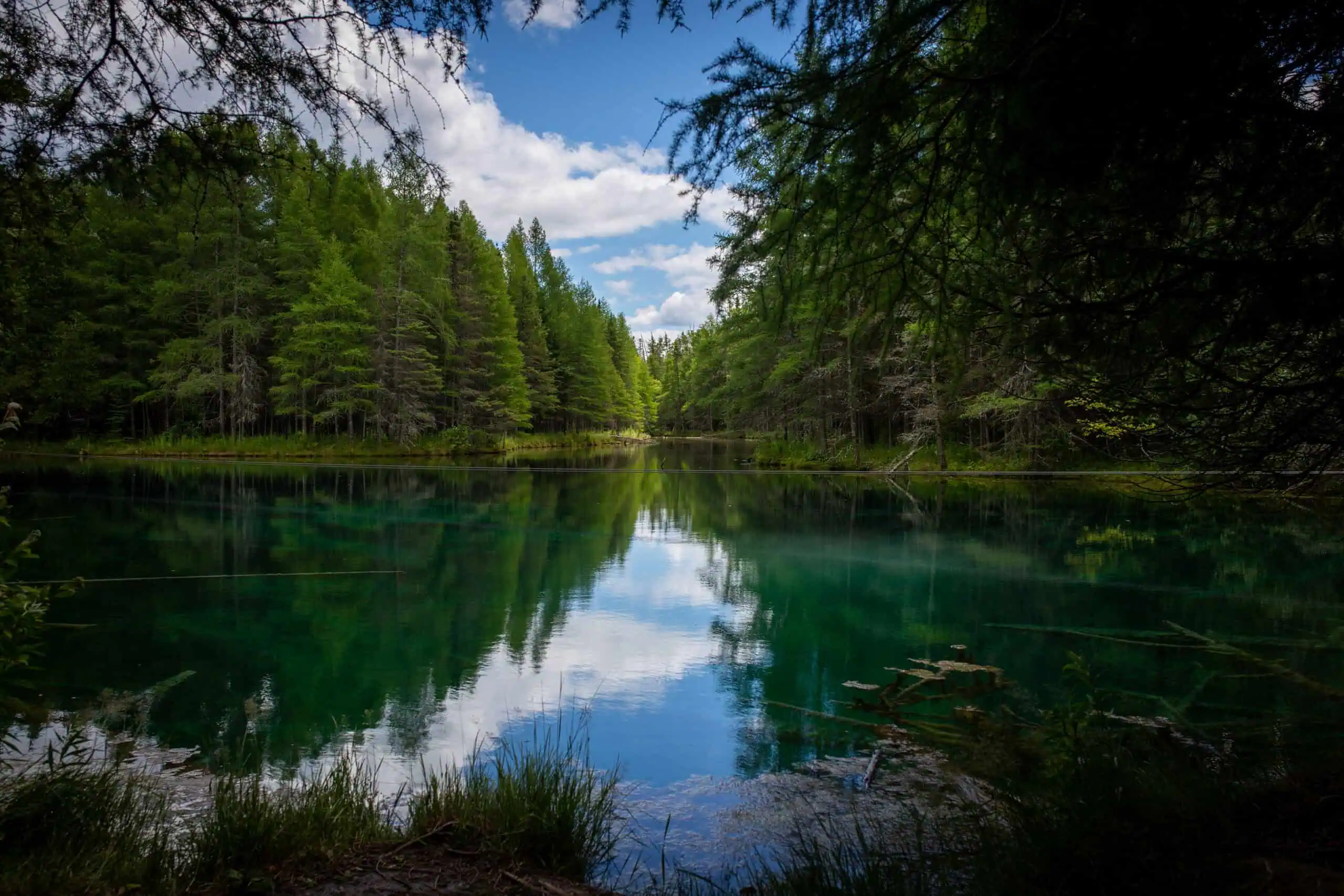
Nearly every sign, brochure, and blog will tell you the spring’s name comes from an ancient Ojibwe legend about a young chief who drowned chasing a maiden’s cruel test of love. It is a good story. It is also, mostly, made up, and not by the Ojibwe.

The five-and-dime owner who invented a legend
In the early 1920s the spring was a forgotten hole in the woods, half buried in fallen timber and used by loggers as a dump. A Manistique five-and-dime owner named John Bellaire fell for it anyway. In 1926 he talked the Palms Book Land Company into selling roughly 90 acres, spring included, to the State of Michigan for ten dollars, on the condition it stay a public park forever.
To pull tourists in, Bellaire simply wrote the ancient Indian legends himself. The Schoolcraft County Historical Society puts it flatly: the name came from a legend Bellaire “created out of his imagination for the sole purpose of luring tourists to the area.” The dramatic tale of the drowned chief on the sign is not centuries old. It is a piece of 1920s marketing that worked so well it is still repeated as fact a hundred years later.

The real story is not gone
This is where it matters to get it right. The spring’s genuine Ojibwe significance is real, and they called it the Mirror of Heaven long before Bellaire showed up. There is also an authentic Ojibwe legend of Kitch-iti-kipi, preserved and retold by Ojibwe storyteller Carole Lynn Hare in her 2020 book, who has been working to get the true version onto the state’s signage. The tourist tale and the real one are not the same thing.
What to know before you go
The spring sits in Palms Book State Park at the north end of M-149, about 12 miles north of US-2 near Manistique. It is open year round, and it almost never freezes, which makes a winter visit to a 45 degree pool surrounded by snow genuinely surreal. You need a Michigan Recreation Passport on your vehicle to get in, there is no separate charge for the raft, and entry on foot or bike is free.
A few things the brochures bury. The raft runs 8 a.m. to dusk, so an evening arrival can find it tied up. The spring is for looking at only: no swimming, no diving, no fishing, and the DNR does not allow drones over the raft. And if a ranger is feeding the trout when you arrive, get on it, because the fish rise and the view straight down beats most aquariums.
Go See It
Kitch-iti-kipi (The Big Spring), Palms Book State Park
- Hours
- 8:00 a.m. to dusk, daily.
- Cost
- Free to view; a Michigan Recreation Passport is required for vehicle entry to the state park.
- Season
- Year-round; the concession stand and restrooms run seasonally.
- Drive
- From Marquette: 1 hr 33 min (88.3 mi) via US-41 S and US-2 E
From the Bridge: 1 hr 43 min (102 mi) via US-2 W
More worth reading


Yooper Hub community
The conversation
Know something this story missed? Corrections and additions get read by an editor and folded into the article, with credit.
Real neighbors, real names. A Yooper Hub editor reads your first comment before it appears; after that you’re a known neighbor and your comments post right away. No account required. Community guidelines
Nothing here yet. A sentence is plenty: a correction, a name, or what you remember about this place.
Sources, credits, and reporting details
Sources & accountability
How this story was reported
Editorial methodAggregation
Last verifiedJul. 13, 2026
Corrections statusNo material correction identified in the July 13, 2026 source review.
AI assistanceResearched and drafted with AI tools. Reviewed and approved by editor Keegan O’Brien.
Verification note: CEO-directed review checked the central claims against 1 direct public evidence link on July 13, 2026. No material correction was identified. Featured image rights and attribution independently verified against the retained source record on 2026-07-14; attachment 1632 restored under Keegan O'Brien dated approval.
Primary sources
-
Direct evidence for: The “Ancient Legend” of Michigan’s Biggest Spring Was Invented in the 1920s — State of Michigan
Accessed Jul. 13, 2026.
Direct public evidence reviewed against the article on July 13, 2026.
Photo and media credits
-
Kitch-iti-kipi — Phillip L. Hofmeister
Featured image record. Accessed Jul. 14, 2026. CC BY-SA 4.0.
none beyond normal attribution and share-alike compliance for the retained derivative.
