The single most famous rock in Upper Peninsula history sits in a storeroom in Washington, D.C., where nobody has been able to see it since 1996. It is the Ontonagon Boulder, 3,708 pounds of nearly pure native copper, sacred to the Ojibwe, seized by the federal government in 1843, and the U.P. has been trying to get it back for generations.
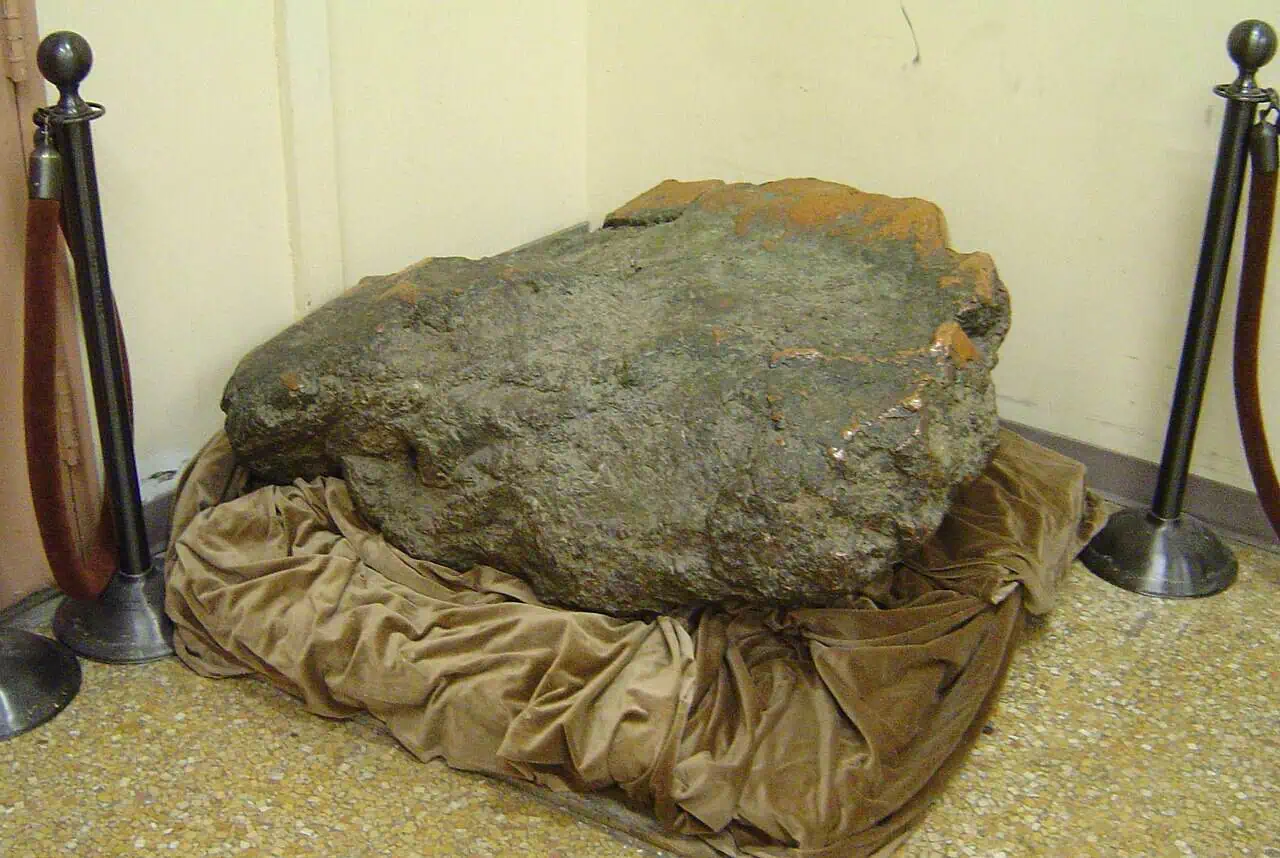

The rock that started everything
A glacier dragged the boulder to the west branch of the Ontonagon River thousands of years ago, and the Ojibwe knew it long before any European did. They called it Misko-biiwaabik, made offerings at it to the Gitche Manitou, and their leaders spoke of the region’s copper as our hope and our protection. French voyageurs were hearing stories about a giant copper rock by the early 1600s, and in 1667 the Jesuit missionary Claude Dablon paddled up the river and confirmed the legend was real. Here is the part most people get backwards: the boulder was not some leftover relic of the U.P.’s copper boom. It caused the boom. Before the boulder was hauled out in 1843, not a single pound of Lake Superior copper had ever been shipped commercially. The rock came out, the world went crazy, and within a generation the U.P. was producing most of the copper in America.
The man who bought it twice and lost it anyway
The man who finally moved it was Julius Eldred, a Detroit hardware merchant who reportedly spent sixteen years scheming to get it. In 1841 he paid Chief Okandekon of the Ontonagon band about 150 dollars for the rock. When he came back in 1843 to collect it, he discovered the Secretary of War had issued a mining permit on that exact land to a crew from Wisconsin, so Eldred paid another 1,365 dollars to buy his own boulder a second time. Then came the hard part. It took his crew of 21 men a full week to winch the rock 50 feet up a bluff, after which they built a portable railroad through the woods, laying track in front and tearing it up behind, for four miles. They rafted it down the river, sailed it to Copper Harbor, and there learned the federal government had decided the boulder now belonged to the United States. Eldred stalled, loaded it onto a schooner in the dead of night, and got it to Detroit, where he charged 25 cents a head to see it. The government took it anyway. In 1847 Congress paid him 5,644 dollars and 93 cents for his trouble, and the boulder went to Washington for good.
A century and a half out of sight
The boulder spent twelve years sitting in a War Department yard, passed through the Patent Office, and landed at the Smithsonian in 1860. Today it belongs to the National Museum of Natural History, and it has not been on public display since 1996. It was supposed to go into the museum’s big hall of geology and gems when that hall opened, but the plan was vetoed at the last minute over engineering concerns, and the rock went back into storage. In 1991 the Keweenaw Bay Indian Community formally asked for it back as a sacred object. In 2000 the Smithsonian’s repatriation office denied the request, ruling the evidence insufficient under federal repatriation law. The awkward footnote: the Smithsonian’s own 1971 published history of the boulder opens by stating flatly that Indians worshiped this copper boulder and that the War Department seized it.
The U.P. still wants it back
The trying has never stopped. In 1955, Ontonagon asked to borrow the boulder for a local celebration, and the Smithsonian said no but shipped up an exact replica, which still sits at the Ontonagon County Historical Museum, the closest most Yoopers will ever get to the real thing. And just last summer, the county historical society formally asked the Keweenaw National Historical Park’s advisory commission to request the real boulder on loan from the Smithsonian, and the commission voted to send a letter of support. Whether the rock that started it all ever comes home, or even gets taken out of the box in Washington, is still an open question after 180 years.
The U.P. gave the country most of its copper, and the country kept the first and most famous piece, in a room nobody can visit. If any rock on earth has earned a trip home, it is this one.
More worth reading


Yooper Hub community
The conversation
Know something this story missed? Corrections and additions get read by an editor and folded into the article, with credit.
Real neighbors, real names. A Yooper Hub editor reads your first comment before it appears; after that you’re a known neighbor and your comments post right away. No account required. Community guidelines
Nothing here yet. A sentence is plenty: a correction, a name, or what you remember about this place.
Sources, credits, and reporting details
Sources & accountability
How this story was reported
Editorial methodAggregation
Last verifiedJul. 13, 2026
Corrections statusNo material correction identified in the July 13, 2026 source review.
AI assistanceResearched and drafted with AI tools. Reviewed and approved by editor Keegan O’Brien.
Verification note: CEO-directed review checked the central claims against 1 direct public evidence link on July 13, 2026. No material correction was identified.
Primary sources
-
Direct evidence for: The Feds Seized the U.P.’s Sacred Copper Boulder in 1843. It’s Still in a Smithsonian Storeroom. — Naturalhistory
Accessed Jul. 13, 2026.
Direct public evidence reviewed against the article on July 13, 2026.
Photo and media credits
-
ontonagon-copper-boulder — Creator or rights holder named in the WordPress attachment caption
Featured image record. Accessed Jul. 13, 2026. CC0.
Supports: Featured image used by this article.
The Ontonagon Boulder itself, photographed off display at the Smithsonian's National Museum of Natural History. Photo: Ian Shackleford / Wikimedia Commons (CC0).