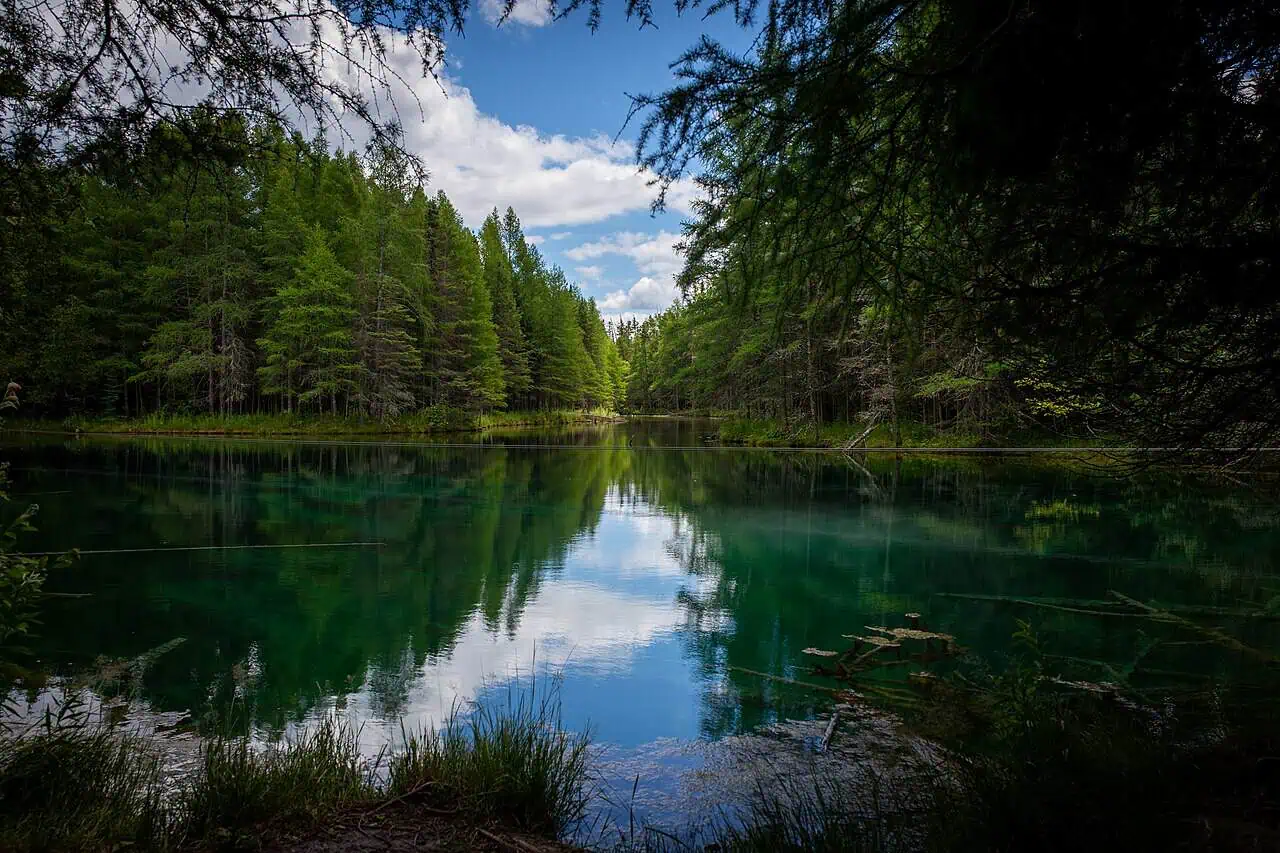
There is a pool of water in the middle of the U.P. that does not look like it belongs on this planet. The water is a clear, glowing emerald green, so transparent you can watch trout hang motionless forty feet down and sand boil up from cracks in the limestone like slow smoke. It is called Kitch-iti-kipi, the Big Spring, and the only way to see it properly is to stand on a wooden raft and pull yourself across the surface by hand.
It is the largest natural freshwater spring in Michigan, an oval pool about 300 feet long and 40 feet deep, tucked into Palms Book State Park north of Manistique. Every minute, more than 10,000 gallons of water push up through fissures in the bedrock, and nobody has ever pinned down exactly where all of it comes from. The spring runs at a constant 45 degrees no matter the season, which is why it sits there glowing while the rest of the U.P. is buried under several feet of snow. It almost never freezes, even when the air outside hits 40 below.

The raft you drive yourself
Most natural wonders keep you at arm’s length. This one hands you the controls. A long wooden raft with a viewing well cut through the middle is strung on a cable, and visitors crank it out to the center of the spring and back themselves, no guide, no engine. Look down through the well and the water is so clear it plays tricks on you. The bottom looks ten feet away instead of forty. Ancient cedar logs, sunk and slowly turned to stone by the cold mineral water, lie scattered below next to branches crusted white with lime. Big trout drift through it all like they are floating in air.
The famous legend is a five-and-dime sales pitch
You will read a tragic Ojibwe legend about the spring, the one about a young chief who drowned here trying to prove his love to a maiden who was only tricking him. It is a good story. It is also, by the confession of the man who spread it, mostly made up. In the 1920s a Manistique five-and-dime owner named John Bellaire found the spring abandoned, used by loggers as a dump, and fell for it. He arranged to sell the land and the spring to the State of Michigan for ten dollars, on the condition it stay a public park forever. Then, by his own admission years later, he and a friend invented most of the dramatic legends to pull in tourists. The real Ojibwe history is older than any of that. They knew the spring for centuries and called it the Mirror of Heaven. But the drowning chief on the souvenir signs came from a guy trying to sell more visitors on his pool.
How to see it
The Big Spring sits at the end of M-149, about 11 miles north of US-2 near Manistique. The raft ride is free, though you need a Michigan Recreation Passport on your plate to drive into the park. There is no swimming, fishing, or diving, this is a look but do not touch kind of place, but the paved path and the raft are both accessible, and the park is open all year. Go in summer and the water is deep emerald. Go in the dead of winter, when everything around it is frozen solid, and you will find the one pool in the U.P. that refuses to ice over, still glowing, still pushing 10,000 gallons a minute up from the dark.
Yoopers have a habit of shrugging off the incredible things in their own backyard. This is one worth the drive. There is nothing else quite like standing on that raft, cranking yourself out over water that looks like glass, and staring down into a forty-foot world that has been quietly bubbling away up there for longer than anyone can explain.
Sources, credits, and reporting details
Sources & accountability
How this story was reported
Legacy source review pending. This published article has not yet passed Yooper’s current source-readiness gate.
Editorial methodNot yet classified
Image provenanceAI imagery status not yet declared
Accountable reviewerNot yet assigned
Last verifiedNot yet recorded
Sources: Michigan DNR / Palms Book State Park; Wikipedia ‘Kitch-iti-kipi’; Upper Peninsula Travel; Upper Michigan’s Source (TV6).
Direct links, claim-level support, dates, credits, and editorial accountability may still be incomplete.