On Christmas Eve more than a century ago, a false cry of “fire” turned a children’s party in Calumet into a tragedy the U.P. has never forgotten
On Christmas Eve of 1913, in the copper-mining town of Calumet, hundreds of children gathered in a second-floor hall for a holiday party. Before the night was over, 73 people were dead, 59 of them children. There had been no fire. It remains the darkest day in the history of Michigan’s Copper Country, and more than a century later, Calumet has not forgotten.
A party during a bitter strike
By Christmas of 1913, the Copper Country had been locked in a bitter standoff for five months. That July, thousands of miners, organized by the Western Federation of Miners, had walked off the job, demanding better pay, shorter hours, and safer conditions from the powerful companies that had built the Copper Country, chief among them Calumet and Hecla. The mines refused to recognize the union, and the strike dragged on into winter.
To bring a little joy to the strikers’ families during a hard season, the Ladies’ Auxiliary of the union organized a Christmas Eve party. It was held on the second floor of the Italian Hall, a building in the heart of Calumet. A red union card was all you needed to get in. By most accounts, around 500 children and some 175 adults packed the hall that night, singing, dancing, and lining up for small gifts.

A single word
Sometime that evening, someone shouted “Fire.” There was no fire. But in a crowded room full of families, the cry set off a panic. People surged toward the only way out, a steep, narrow stairway leading down to the street. Those at the top pushed forward to escape. Those who fell at the bottom could not get up. In a matter of minutes, the stairwell became a crush from which dozens could not be pulled free.
When it was over, 73 people had been crushed or suffocated to death on that stairway. Fifty-nine of them were children. The youngest was two years old. Many were the sons and daughters of Finnish, Croatian, Slovenian, and Italian immigrants who had come to the Copper Country for work in the mines.
A question never answered
Who shouted “fire” has never been known. The person was never identified and never came forward. In the raw grief and anger that followed, many in the union were certain the cry had come from someone hostile to the strike, and some witnesses said the man wore the button of the Citizens’ Alliance, an anti-union group. But nothing was ever proven. Investigations were hampered by the fact that the great majority of Calumet’s residents were immigrants who spoke little English, yet were made to testify in English all the same. The inquiries reached no firm conclusion, and the Citizens’ Alliance was formally cleared.

How Calumet remembers
The strike ended a few months later, in the spring of 1914, with the union no closer to its goals. But the memory of that night never faded. The folk singer Woody Guthrie set the tragedy to music in his 1941 ballad “1913 Massacre,” carrying the story far beyond the U.P., though his version took some liberties with the facts.
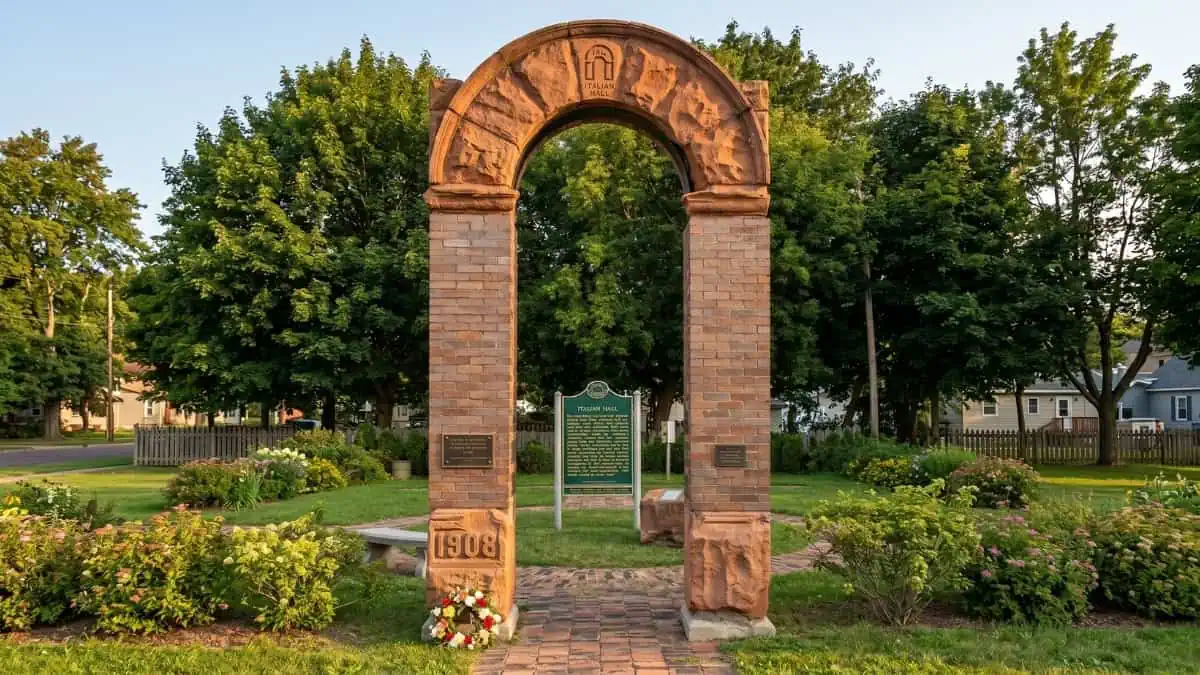
The Italian Hall itself was torn down in 1984. But the town saved the building’s sandstone archway, the doorway so many had rushed toward that night, and it still stands today as a memorial in a quiet park in Calumet, now part of Keweenaw National Historical Park. In 2018, a granite monument was dedicated nearby, carved with the names of all 73 victims. And every year on Christmas Eve, the community gathers at the site to remember them.
The Italian Hall disaster has been studied, debated, sung about, and mourned for over a hundred years. The full truth of what happened on that stairway may never be settled. But the names on that monument, most of them children who should have had long lives ahead of them, make sure that the people of Calumet, and anyone who comes to stand beneath that old stone arch, will not forget the Christmas Eve the Copper Country lost so much.
Photo by Chris857, via Wikimedia Commons, CC BY-SA 4.0. Cropped and enhanced for Yooper Hub.
Explore more: Keweenaw Stories
More worth reading


Yooper Hub community
The conversation
Know something this story missed? Corrections and additions get read by an editor and folded into the article, with credit.
Real neighbors, real names. A Yooper Hub editor reads your first comment before it appears; after that you’re a known neighbor and your comments post right away. No account required. Community guidelines
Nothing here yet. A sentence is plenty: a correction, a name, or what you remember about this place.
Sources, credits, and reporting details
Sources & accountability
How this story was reported
Editorial methodService and public-interest reporting
Last verifiedJul. 13, 2026
Corrections statusNo material correction identified in the July 13, 2026 source review.
AI assistanceResearched and drafted with AI tools. Reviewed and approved by editor Keegan O’Brien.
Verification note: CEO-directed review checked the central claims against 1 direct public evidence link on July 13, 2026. No material correction was identified.
Primary sources
-
Direct evidence for: The 1913 Italian Hall Disaster Is the Copper Country’s Darkest Day, and Calumet Still Remembers — National Park Service
Accessed Jul. 13, 2026.
Direct public evidence reviewed against the article on July 13, 2026.
Photo and media credits
-
Italian Hall Memorial Arch in Calumet — Creator or rights holder named in the WordPress attachment caption
Featured image record. Accessed Jul. 13, 2026. CC BY-SA 4.0.
Supports: Featured image used by this article.
The Italian Hall memorial arch in Calumet, where the 1913 disaster is remembered today. Photo by Chris857, via Wikimedia Commons, CC BY-SA 4.0. Cropped and enhanced for YooperHub.